
NEET 2026
- Exam
- NEET
- Year
- 2026
- Subject
- Chemistry
- Chapter
- Thermodynamics (C)
NEET 2026 · Chemistry · Thermodynamics (C)
Consider the reversible processes for 1.0 mol of an ideal gas as...
Consider the reversible processes for mol of an ideal gas as shown in the figure.
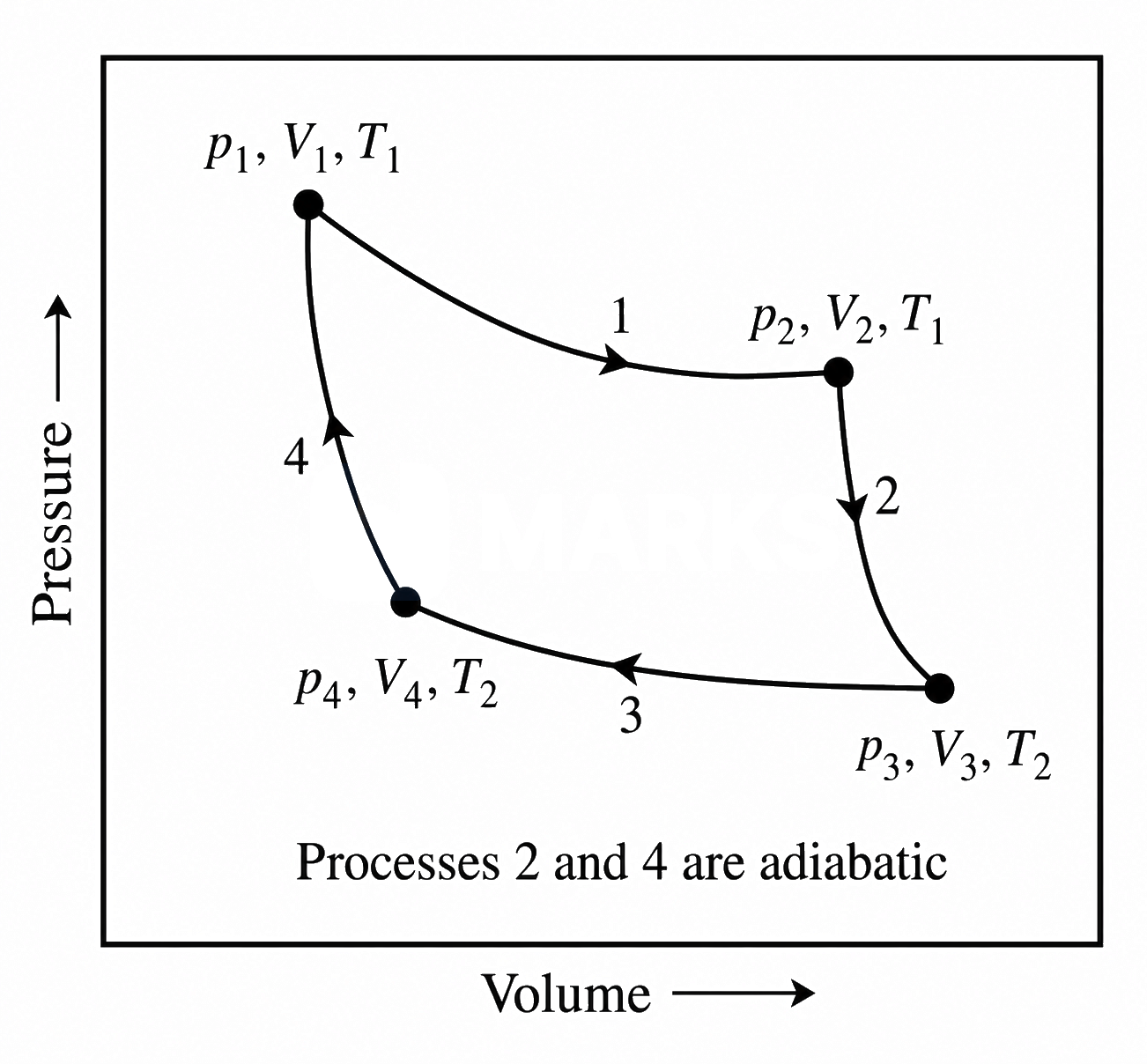
Processes 2 and 4 are adiabatic. , , and represent work done (in calories) in the processes 1, 2, 3 and 4, respectively; and are changes in the internal energy for the processes 2 and 4, respectively.
[use R cal K mol]
The correct option is
Processes 2 and 4 are adiabatic. , , and represent work done (in calories) in the processes 1, 2, 3 and 4, respectively; and are changes in the internal energy for the processes 2 and 4, respectively.
[use R cal K mol]
The correct option is
Options
- A
- B
- C
- D
Correct answer
B.
Step-by-step solution
Using the IUPAC sign convention for thermodynamics, work done is given by .
For the isothermal reversible process 1 (from volume to at constant temperature ):
Given mol and cal K mol, we have:
For the isothermal reversible process 3 (from volume to at constant temperature ):
Adding the work done in these two processes:
Let us also verify the other options to be sure.
For option (1): The net work done in a reversible cycle is the area enclosed by the curve, which is non-zero. Thus, .
For option (3): In adiabatic processes, , so from the first law of thermodynamics, .
Therefore, and .
This gives .
Since internal energy is a state function, for the complete cycle .
For isothermal processes 1 and 3, and .
Thus, , which means .
However, .
Hence, .
For option (4): .
Answer: