Quantrex Quantrex AcademyJEE · NEET · NDA PYQs with solutions Open app
NEET 2026
Exam
NEET
Year
2026
Subject
Physics
Chapter
Atomic Physics

NEET 2026 · Physics · Atomic Physics

In Geiger-Marsden experiment, the number of scattered α -particles...

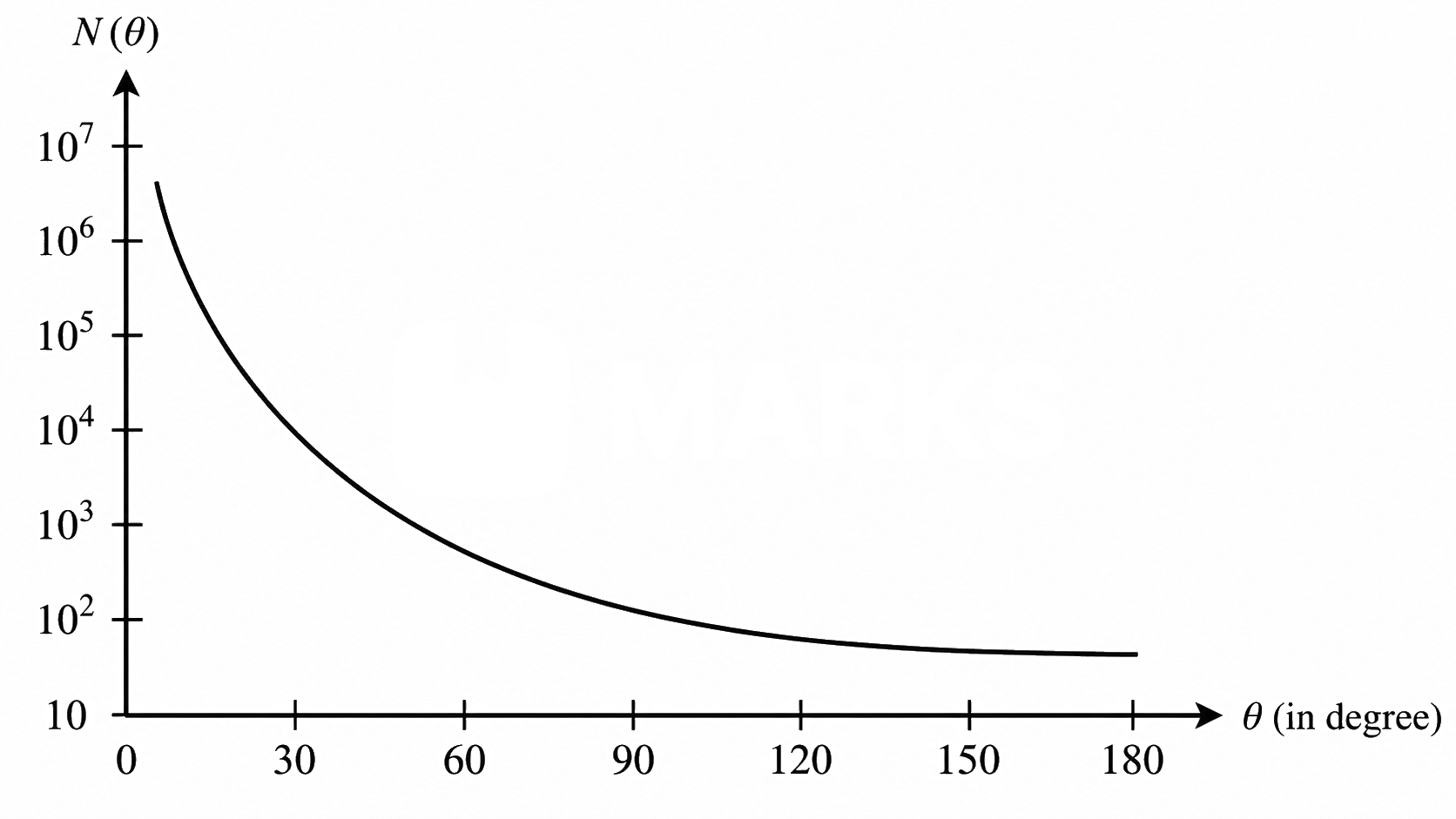
In Geiger-Marsden experiment, the number of scattered α\alpha-particles N(θ)N(\theta) is plotted as a function of scattering angle θ\theta. Which of the following options represents the correct plot ?In Geiger-Marsden experiment, the number of scattered α -particles N(θ) is plotted as a function of scattering angle θIn Geiger-Marsden experiment, the number of scattered α -particles N(θ) is plotted as a function of scattering angle θIn Geiger-Marsden experiment, the number of scattered α -particles N(θ) is plotted as a function of scattering angle θIn Geiger-Marsden experiment, the number of scattered α -particles N(θ) is plotted as a function of scattering angle θIn Geiger-Marsden experiment, the number of scattered α -particles N(θ) is plotted as a function of scattering angle θ
Options

  1. AA piece of wood is submerged deep inside a long column of water and released. It will move upwards
  2. BA piece of wood is submerged deep inside a long column of water and released. It will move upwards
  3. CA piece of wood is submerged deep inside a long column of water and released. It will move upwards
  4. DA piece of wood is submerged deep inside a long column of water and released. It will move upwards

Correct answer

D. A piece of wood is submerged deep inside a long column of water and released. It will move upwards

Step-by-step solution

In the Geiger-Marsden (α\alpha-particle scattering) experiment, the number of α\alpha-particles scattered at an angle θ\theta is given by the Rutherford scattering formula:

N(θ)∝1sin⁡4(θ/2)N(\theta) \propto \dfrac{1}{\sin^4(\theta/2)}

From this relation, we can observe the following:
1. For small values of θ\theta, sin⁡(θ/2)\sin(\theta/2) is very small, making N(θ)N(\theta) very large. Most α\alpha-particles pass through with very little deflection.
2. As the scattering angle θ\theta increases, sin⁡(θ/2)\sin(\theta/2) increases, causing the number of scattered particles N(θ)N(\theta) to decrease rapidly.
3. The minimum number of scattered particles occurs at θ=180∘\theta = 180^\circ, where sin⁡(180∘/2)=sin⁡(90∘)=1\sin(180^\circ/2) = \sin(90^\circ) = 1.

The graph that correctly represents this rapid decrease from a very high value at small angles to a low value at large angles is shown in option (4).

Answer: In Geiger-Marsden experiment, the number of scattered α -particles N(θ) is plotted as a function of scattering angle θ
Practice Atomic Physics on Quantrex Academy →

More from Atomic Physics

The energy levels of certain atom are represented in the following figure. During the… MHT CET Medical 2026The ratio of ionization energy of a hydrogen atom in fifth excited state to second… MHT CET Medical 2026The wavelength of radiation emitted is ' λ ' when an electron jumps from second to first… MHT CET Medical 2026The angular momentum of an electron in Bohr's hydrogen atom having energy -0.544 eV is (h… MHT CET Medical 2026An electron of mass ' m_e ' and charge ' e ' revolving around the nucleus in n^ th orbit… MHT CET Medical 2026The ratio of angular frequency (ω ) of an electron to the total energy ( E) of an… MHT CET Medical 2026The ratio between the areas of Bohr's first three orbits of the hydrogen atom are MHT CET Medical 2026A hydrogen atom in its ground state is irradiated by light of wavelength 1026\ Å . The… MHT CET Medical 2026 Full Atomic Physics list All NEET PYQs