
NEET 2026
- Exam
- NEET
- Year
- 2026
- Subject
- Physics
- Chapter
- Dual Nature of Matter
NEET 2026 · Physics · Dual Nature of Matter
A beam of light falls on a metal surface such that photo-electrons...
A beam of light falls on a metal surface such that photo-electrons are generated. If power of the light source starts to decrease linearly with time , then variation of the photocurrent and magnitude of the stopping potential with time is best represented by :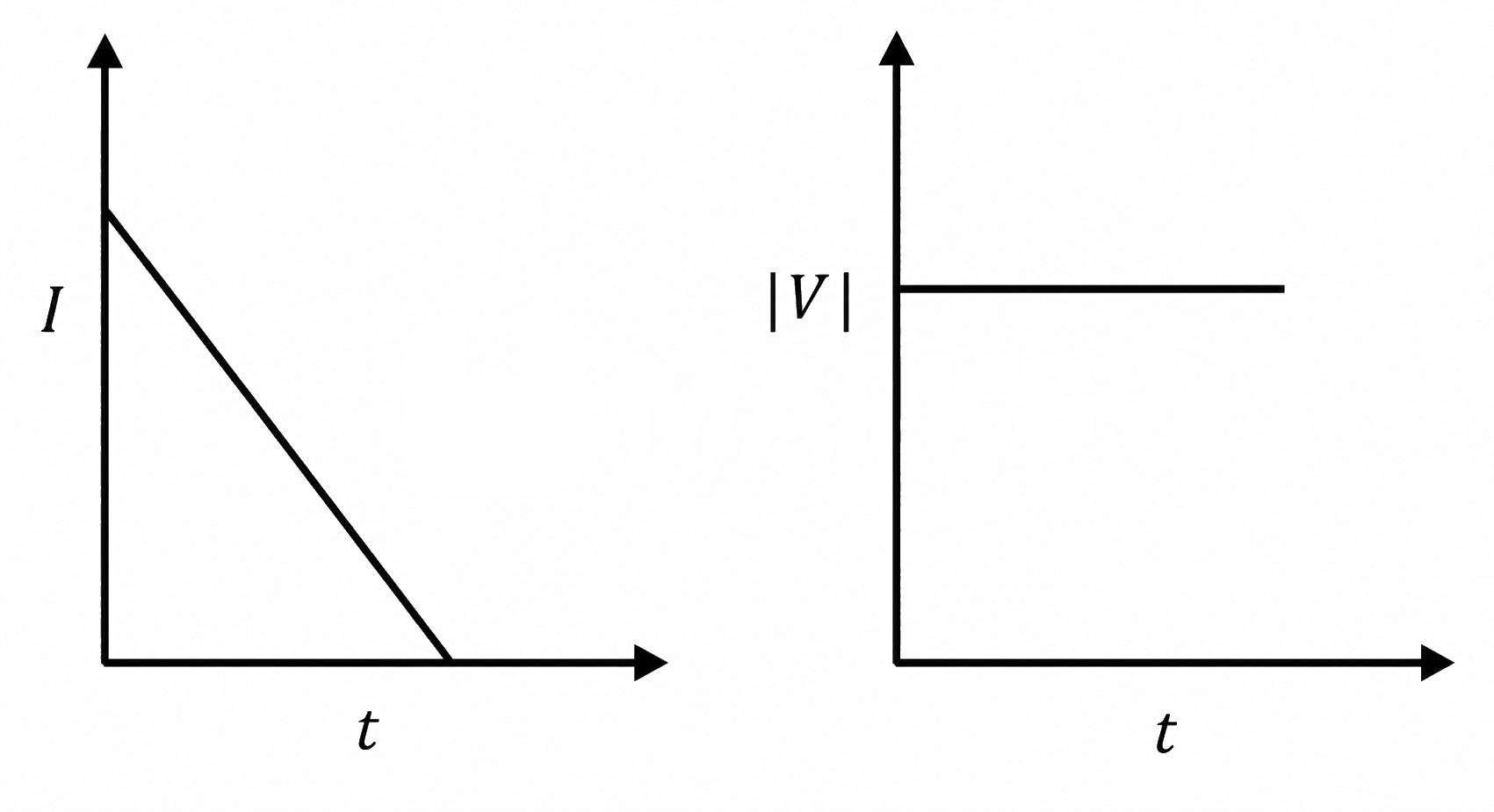


Options
- A

- B

- C

- D

Correct answer
B.
Step-by-step solution
The power of the incident light is , where is the number of photons incident per unit time and is the frequency.
As the power decreases linearly with time, the number of incident photons also decreases linearly, assuming the frequency remains constant.
The photocurrent is directly proportional to the number of incident photons per unit time (). Thus, the photocurrent decreases linearly with time.
The stopping potential is given by Einstein's photoelectric equation , where is the work function of the metal.
Since the frequency and the work function are constant, the stopping potential remains constant over time, independent of the light's power.
Therefore, the graph of versus is a straight line with a negative slope, and the graph of versus is a horizontal line.
Answer :