
NEET 2026
- Exam
- NEET
- Year
- 2026
- Subject
- Physics
- Chapter
- Electrostatics
NEET 2026 · Physics · Electrostatics
A unit positive point charge is taken slowly through an...
A unit positive point charge is taken slowly through an infinitesimally thin tube that is inside a charged dielectric sphere of radius , having uniform positive charge density , as shown in the figure. The initial and final positions of the charge are marked by and at distances and respectively, from the centre of the sphere. In this process, the magnitude of the total work done on the point charge is . The value of is :
( is the permittivity of vacuum)
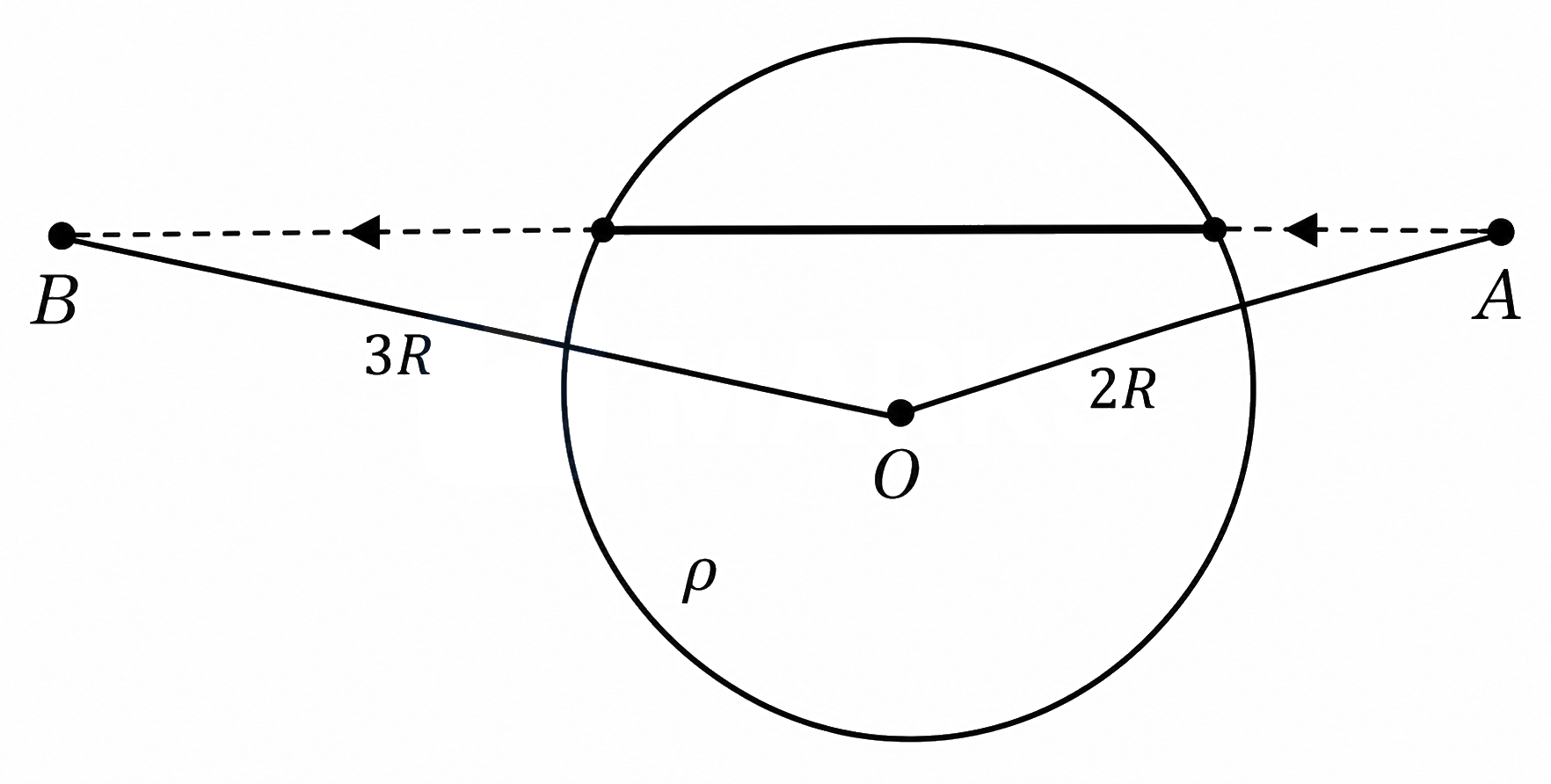
( is the permittivity of vacuum)
Options
- A
- B
- C
- D
Correct answer
A.
Step-by-step solution
Since the electrostatic field is conservative, the work done in moving a charge depends only on the potential difference between the initial and final positions, regardless of the path taken.
The electric potential at a distance () from the centre of a uniformly charged solid sphere of radius and charge density is given by:
The total charge of the sphere is:
Substituting into the potential formula, we get:
The initial position is at a distance from the centre. The potential at is:
The final position is at a distance from the centre. The potential at is:
The work done by the external agent in moving a unit positive charge () slowly from to is equal to the change in its potential energy:
The magnitude of the total work done is:
Comparing this with the given expression , we find:
Answer: