The magnetic field at the centre of an arc subtended at an angle
θ is given by
B=2Rμ0i×2πθ
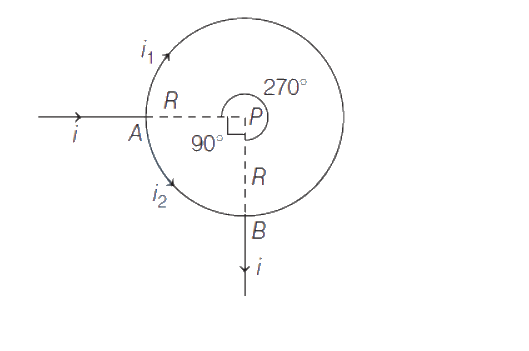
Then, the magnetic field due to larger arc
AB is
B1=2Rμ0i1×2π270
which acts in inward direction according to right hand thumb rule.
And magnetic field due to smaller arc
AB is
B2=2Rμ0i2×2π90
which acts in outward direction.
The resultant magnetic field
BR=B1+B2=−4πRμ0i1×270+4πRμ0i2×90 [From Eq. (i) and (ii)]
which acts in inward direction as
B1>B2.
Two arcs can also be seen as the two resistances in parallel combination.
So, the potential across them will be same i.e.
V1i1R1=V2=i2R2
where,
R1 and
R2= Resistance of respective segments
The wire is uniform so
R2R1= L2L1=R×90R×270[∵ length of arc = radius × angle]
From Eq. (iv), we get
⇒i2i1=R1R2=27090=31 or 3 i_1=i_2
From Eq. (iii) and (v), we get
BR=4πRμ0(−270i1+90i2)=4πRμ0[−270i1+90(3i1)]=4πRμ0(−270i1+270i1)=0
