Quantrex Quantrex AcademyJEE · NEET · NDA PYQs with solutions Open app
NEET
Exam
NEET
Subject
Physics
Chapter
Rotational Motion

NEET · Physics · Rotational Motion

A particle of mass ( m ) is projected at a velocity ( u ), making...

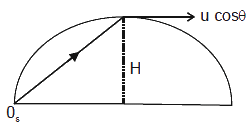
A particle of mass (m\mathrm{m}) is projected at a velocity (u\mathrm{u}), making an angle (θ\theta) with the horizontal ( (x\mathrm{x})-axis). If the angle of projection (θ\theta) is varied keeping all other parameters same, then magnitude of angular momentum (L) at its maximum height about the point of projection varies with (θ\theta) as,A particle of mass ( m ) is projected at a velocity ( u ), making an angle ( θ ) with the horizontal ( ( x )-axis). IfA particle of mass ( m ) is projected at a velocity ( u ), making an angle ( θ ) with the horizontal ( ( x )-axis). IfA particle of mass ( m ) is projected at a velocity ( u ), making an angle ( θ ) with the horizontal ( ( x )-axis). IfA particle of mass ( m ) is projected at a velocity ( u ), making an angle ( θ ) with the horizontal ( ( x )-axis). IfA particle of mass ( m ) is projected at a velocity ( u ), making an angle ( θ ) with the horizontal ( ( x )-axis). If

Options

  1. ADuring the beginning of ventricular diastole, as the ventricular pressure declines, a distinct acoustic event is
  2. BDuring the beginning of ventricular diastole, as the ventricular pressure declines, a distinct acoustic event is
  3. CDuring the beginning of ventricular diastole, as the ventricular pressure declines, a distinct acoustic event is
  4. DDuring the beginning of ventricular diastole, as the ventricular pressure declines, a distinct acoustic event is

Correct answer

D. During the beginning of ventricular diastole, as the ventricular pressure declines, a distinct acoustic event is

Step-by-step solution

Hint : A particle of mass ( m ) is projected at a velocity ( u ), making an angle ( θ ) with the horizontal ( ( x )-axis). If
L0=mucos⁡θH=mucos⁡θu2sin⁡2θ2 g=mu3sin⁡2θcos⁡θ2 g\begin{aligned} & \mathrm{L}_0=m u \cos \theta \mathrm{H} \\ & =m u \cos \theta \frac{\mathrm{u}^2 \sin ^2 \theta}{2 \mathrm{~g}} \\ & =\frac{m u^3 \sin ^2 \theta \cos \theta}{2 \mathrm{~g}} \end{aligned}) LL is zeroforfor(\theta=0^{\circ}) and (\theta=\frac{\pi}{2})$
Practice Rotational Motion on Quantrex Academy →

More from Rotational Motion

A solid sphere A of radius R and mass M is attached at a point to a smaller solid sphere… NEET 2026The angular speed of a flywheel is increased from 600 rpm to 1200 rpm in 10 s. The number… NEET 2026A thin wire of length ' L ' and linear mass density ' m ' is bent into a circular ring… NEET 2026A thin horizontal disc is rotating about a vertical axis passing through its fixed centre… NEET 2026The Sun rotates around its centre once in 27 days. What will be the period of revolution… NEET 2025A sphere of radius R is cut from a larger solid sphere of radius 2 R as shown in the… NEET 2025The radius of gyration of a solid sphere of mass 5 kg about X Y is 5 m as shown in… NEET 2024A wheel of a bullock cart is rolling on a level road as shown in the figure below. If its… NEET 2024 Full Rotational Motion list All NEET PYQs