Quantrex Quantrex AcademyJEE · NEET · NDA PYQs with solutions Open app
NEET
Exam
NEET
Subject
Physics
Chapter
Gravitation

NEET · Physics · Gravitation

The mass density of a spherical body is given by ρ(r) = (k)/(r) for...

The mass density of a spherical body is given by ρ(r)=krρ\left(r\right) = \dfrac{k}{r} for r≤Rr \le R and ρ(r)=0ρ\left(r\right) = 0 for r>R,r > R, where r is the distance from the centre. The correct graph that describes qualitatively the acceleration, a, of a test particle as a function of r is :The mass density of a spherical body is given by ρ(r) = (k)/(r) for r ≤ R and ρ(r) = 0 for r > R, where r is theThe mass density of a spherical body is given by ρ(r) = (k)/(r) for r ≤ R and ρ(r) = 0 for r > R, where r is theThe mass density of a spherical body is given by ρ(r) = (k)/(r) for r ≤ R and ρ(r) = 0 for r > R, where r is theThe mass density of a spherical body is given by ρ(r) = (k)/(r) for r ≤ R and ρ(r) = 0 for r > R, where r is theThe mass density of a spherical body is given by ρ(r) = (k)/(r) for r ≤ R and ρ(r) = 0 for r > R, where r is the
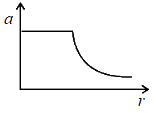
Options

  1. AA thin convergent glass lens (μ_ g =1.5) has a power of +5.0 D . When this lens is immersed in a liquid of refractive
  2. BA thin convergent glass lens (μ_ g =1.5) has a power of +5.0 D . When this lens is immersed in a liquid of refractive
  3. CA thin convergent glass lens (μ_ g =1.5) has a power of +5.0 D . When this lens is immersed in a liquid of refractive
  4. DA thin convergent glass lens (μ_ g =1.5) has a power of +5.0 D . When this lens is immersed in a liquid of refractive

Correct answer

A. A thin convergent glass lens (μ_ g =1.5) has a power of +5.0 D . When this lens is immersed in a liquid of refractive

Step-by-step solution

The mass density of a spherical body is given by ρ(r) = (k)/(r) for r ≤ R and ρ(r) = 0 for r > R, where r is the

 For Inside point (r≤R)\left(r \le R\right)

g=E=Gr2∫0r(4πr2dr)(Kr)g = E = \dfrac{G}{{r}^{2}}\mathop{∫}_{0}^{r}\left(4\pi{r}^{2}dr\right)\left(\dfrac{K}{r}\right)
GKr2×4πr22=2\piGK=constant\dfrac{GK}{{r}^{2}} \times \dfrac{4\pi{r}^{2}}{2} = 2\piGK = constant

For outside point \left(r > R\right)<br/><br/><br/><br/>E = g = \dfrac{GM}{{r}^{2}} = \dfrac{G}{{r}^{2}} \mathop{∫}_{0}^{R} ( 4\pi{r}^{2} d{r}^{′} )( \dfrac{K}{{r}^{′}} ) = \dfrac{4\piKG}{{r}^{2}} {[ \dfrac{{{r}^{′}}^{2}}{2} ]}_{0}^{R}<br/><br/><br/><br/>E = g = \dfrac{2\piKG}{{r}^{2}}{R}^{2}<br/><br/><br/><br/>E ∝ \dfrac{1}{{r}^{2}}
Practice Gravitation on Quantrex Academy →

More from Gravitation

The amount of work done to raise a mass ' m ' from the surface of the Earth to a height… NEET 2026Two planets P_1 and P_2 with equal mass have radii R_1 and R_2 , respectively, where… NEET 2026In a solar system, the time-period of revolution of a planet tracing a circular orbit of… NEET 2026The radius of Martian orbit around the Sun is about 4 times the radius of the orbit of… NEET 2025A body weighs 48 N on the surface of the earth. The gravitational force experienced by… NEET 2025The escape velocity for earth is v . A planet having 9 times mass that of earth and… NEET 2024The mass of a planet is (1)/(10) th that of the earth and its diameter is half that of… NEET 2024An object of mass 100 kg falls from point A to B as shown in figure. The change in its… NEET 2024 Full Gravitation list All NEET PYQs