
NEET
- Exam
- NEET
- Subject
- Physics
- Chapter
- Oscillations
NEET · Physics · Oscillations
The graph plotted between phase angle ((φ)) and displacement of a...
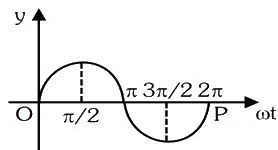
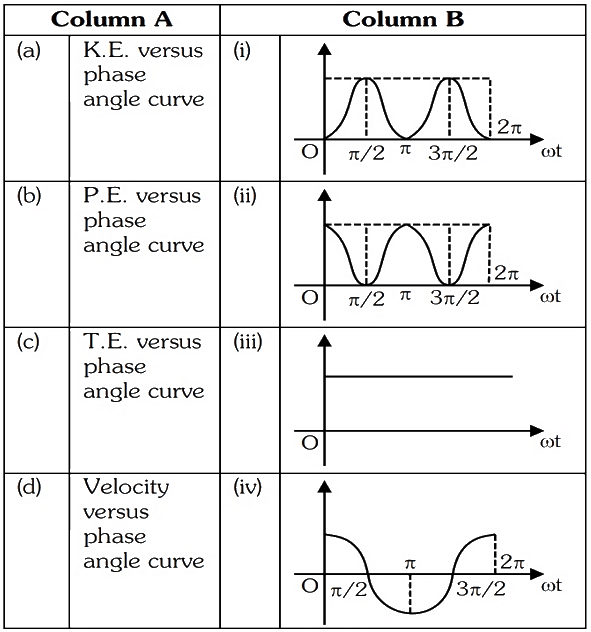
The graph plotted between phase angle ((\phi)) and displacement of a particle from equilibrium position (y) is a sinusoidal curve as shown below. Then the best matching is
Options
- A(a)-(i), (b)-(ii), (c)-(iii) & (d)-(iv)
- B(a)-(ii), (b)-(i), (c)-(iii) & (d)-(iv)
- C(a)-(ii), (b)-(i), (c)-(iv) & (d)-(iii)
- D(a)-(ii), (b)-(iii), (c)-(iv) & (d)-(i)
Correct answer
B. (a)-(ii), (b)-(i), (c)-(iii) & (d)-(iv)
Step-by-step solution
Key Relationships in SHM:
1. Displacement vs. Phase Angle (\phi) : The displacement from the equilibrium position varies sinusoidally with respect to time and phase angle.
2. Kinetic Energy (K.E.):
- K.E. is maximum when the displacement is zero (i.e., at the mean position).
- It varies sinusoidally and reaches zero at the maximum displacements (() A).
- K.E. vs. Phase Angle: This will be a cosine-like curve because it is maximum at (\phi=0) and (\phi=) (mean position) and zero at (\phi=) and () (maximum displacements).
3. Potential Energy (P.E.):
- P.E. is maximum when the displacement is maximum (()) and zero at the mean position.
- P.E. vs. Phase Angle: This will also be a cosine-like curve that is maximum at (\phi=) and () (maximum displacements) and zero at (\phi=0) and (\phi=) (mean position).
4. Total Energy (T.E.):
- T.E. remains constant in SHM and is equal to the maximum potential or kinetic energy.
- T.E. vs. Phase Angle: This is a constant line across all phase angles.
5. Velocity:
- Velocity is maximum when displacement is zero (mean position) and zero when displacement is maximum.
- Velocity vs. Phase Angle: This will be a sine wave, starting from zero at (\phi=0) and reaching maximum at (\phi=).
Matching the Columns:
- (a) K.E. versus phase angle: Matches with (ii) (cosine curve).
(b) P.E. versus phase angle: Matches with (i) (also cosine curve, but maximum at extremes).
(c) T.E. versus phase angle: Matches with (iv) (constant value).
- (d) Velocity versus phase angle: Matches with (iii) (sine wave).