Quantrex Quantrex AcademyJEE · NEET · NDA PYQs with solutions Open app
NEET
Exam
NEET
Subject
Physics
Chapter
Nuclear Physics

NEET · Physics · Nuclear Physics

The rate of disintegration of a radioactive sample is R and the...

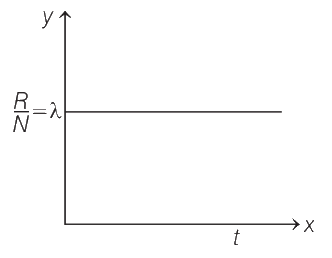
The rate of disintegration of a radioactive sample is RR and the number of atoms present at any time tt is NN. When RN\frac{R}{N} is taken along YY-axis and tt is taken along XX-axis, the correct graphs isThe rate of disintegration of a radioactive sample is R and the number of atoms present at any time t is N . WhenThe rate of disintegration of a radioactive sample is R and the number of atoms present at any time t is N . WhenThe rate of disintegration of a radioactive sample is R and the number of atoms present at any time t is N . WhenThe rate of disintegration of a radioactive sample is R and the number of atoms present at any time t is N . WhenThe rate of disintegration of a radioactive sample is R and the number of atoms present at any time t is N . WhenThe rate of disintegration of a radioactive sample is R and the number of atoms present at any time t is N . When

Options

  1. AThe average molar mass of chlorine is 35 . 5g mol ^ - 1 . The ratio of Cl 35 to Cl 37 in naturally occurring chlorine
  2. BThe average molar mass of chlorine is 35 . 5g mol ^ - 1 . The ratio of Cl 35 to Cl 37 in naturally occurring chlorine
  3. CThe average molar mass of chlorine is 35 . 5g mol ^ - 1 . The ratio of Cl 35 to Cl 37 in naturally occurring chlorine
  4. DThe average molar mass of chlorine is 35 . 5g mol ^ - 1 . The ratio of Cl 35 to Cl 37 in naturally occurring chlorine

Correct answer

D. The average molar mass of chlorine is 35 . 5g mol ^ - 1 . The ratio of Cl 35 to Cl 37 in naturally occurring chlorine

Step-by-step solution

Law of radioactive decay is given as, dNdt=−λ\frac{d N}{d t}=-\lambdaN where, dNdt=\frac{d N}{d t}= rate of disintegration So, <imgsrc="https://firebasestorage.googleapis.com/v0/b/quantrexacademy−app.firebasestorage.app/o/questions<img src="https://firebasestorage.googleapis.com/v0/b/quantrexacademy-app.firebasestorage.app/o/questions%2Ffigs%2Fdiagrams%2Fqx-self-2d88a7ca8b7d0246.png?alt=media&v=stem2" data-qx-orig-src="/assets/diagrams/qx-self-2d88a7ca8b7d0246.png" data-qx-storage-src="/assets/diagrams/qx-self-2d88a7ca8b7d0246.png"> \\ R=-\lambda N \Rightarrow RN=−λ= constant \frac{R}{N}=-\lambda=\text{ constant }where, λ=\lambda= decay constant So, the graph RN\frac{R}{N} versus tt is as, So, the correct graph shown in option (d).
Practice Nuclear Physics on Quantrex Academy →

More from Nuclear Physics

Consider the following nuclear fission reaction _0^1 n + _ 92 ^ 235 U arrow _Z^A Y + _ 41… MHT CET Medical 2026Two spherical nuclei have mass numbers 216 and 64 with their radii R_1 and R_2… MHT CET Medical 2026At time t = 0 , the activity of a radioactive substance is 1600 Bq. At t= 8 s, the… MHT CET Medical 2026A radioactive nucleus _ 92 X^ 235 decays to _ 91 Y^ 231 . Which of the following… MHT CET Medical 2026In a given reaction, ^ A _ Z X arrow ^ A _ Z+1 Y arrow ^ A-4 _ Z-1 K arrow ^ A-4 _ Z-1 K… MHT CET Medical 2026When a nucleus in an atom undergoes a radioactive decay, the atomic number and/or mass… MHT CET Medical 2026A common example of β^- decay is _ 15 ^ 32 _ 16 ^ 32 + x + y Then x and y , respectively… MHT CET Medical 2026For a radioactive nucleus that undergoes β^+ decay, which of the following CANNOT occur? MHT CET Medical 2026 Full Nuclear Physics list All NEET PYQs