
NEET
- Exam
- NEET
- Subject
- Physics
- Chapter
- Nuclear Physics
NEET · Physics · Nuclear Physics
Some laws/processes are given in Column I. Match these with the...
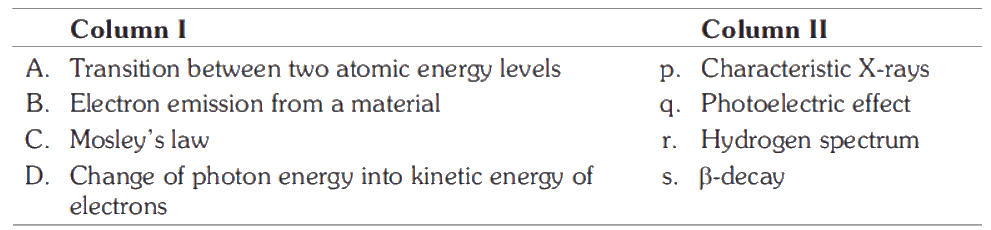
Some laws/processes are given in Column I. Match these with the physical phenomena given in Column II and indicate your answer by darkening appropriate bubbles in the matrix given in the ORS.
Options
- AA-p, r; B-p, q, s; C-p; D-q
- BA-p; B-p, s; C-p; D-q
- CA-p, r; B-p, q; C-p, r; D-q, s
- DA-r, s; B-q; C-p; D-p, q, s
Correct answer
A. A-p, r; B-p, q, s; C-p; D-q
Step-by-step solution
(A) Transition between two atomic energy levels
When an electron in an atom transitions from a higher energy level to a lower one, it emits a photon with a specific energy. This is the fundamental principle behind the emission spectra of elements. The hydrogen spectrum is a classic example of this process, where discrete spectral lines are observed due to transitions between specific energy levels.
- A matches with r.
(B) Electron emission from a material
Electron emission from a material can happen in several ways. One common method is by bombarding the material with photons. If the photons have sufficient energy, they can dislodge electrons from the material's surface. This phenomenon is known as the photoelectric effect.
- B matches with q.
(C) Mosley's law
Moseley's law describes the relationship between the frequency of characteristic X-rays emitted from an element and its atomic number. It states that the square root of the frequency of the emitted X-ray is directly proportional to the atomic number of the element.
- C matches with p.
(D) Change of photon energy into kinetic energy of electrons
This process is the core of the photoelectric effect. A photon with energy strikes a material. Some of this energy is used to overcome the work function ((\phi)) of the material, and the rest is converted into the kinetic energy of the emitted electron ((\mathrm{K}_{\text{max }})). The equation is (\mathrm{h} \mathrm{f}= \phi+K_{\text{max }}).
- D matches with q.
Conclusion
Based on this analysis, the correct pairings are:
- (\mathrm{A} \rightarrow \mathrm{r})
- (\mathrm{B} \rightarrow \mathrm{q})
- (\mathrm{C} \rightarrow \mathrm{p})
- (\mathrm{D} \rightarrow \mathrm{q})
This corresponds to option (1). Note that the question has B and D both matching to q, which is a common scenario when both descriptions apply to the same physical phenomenon.