
JEE Advanced 2026Paper 1
- Exam
- JEE Advanced
- Year
- 2026
- Paper
- Paper 1
- Subject
- Chemistry
- Chapter
- Carboxylic Acid Derivatives
JEE Advanced 2026 · Paper 1 · Chemistry · Carboxylic Acid Derivatives
The sum of total number of carbonyl groups ( >C=O ) present in the...
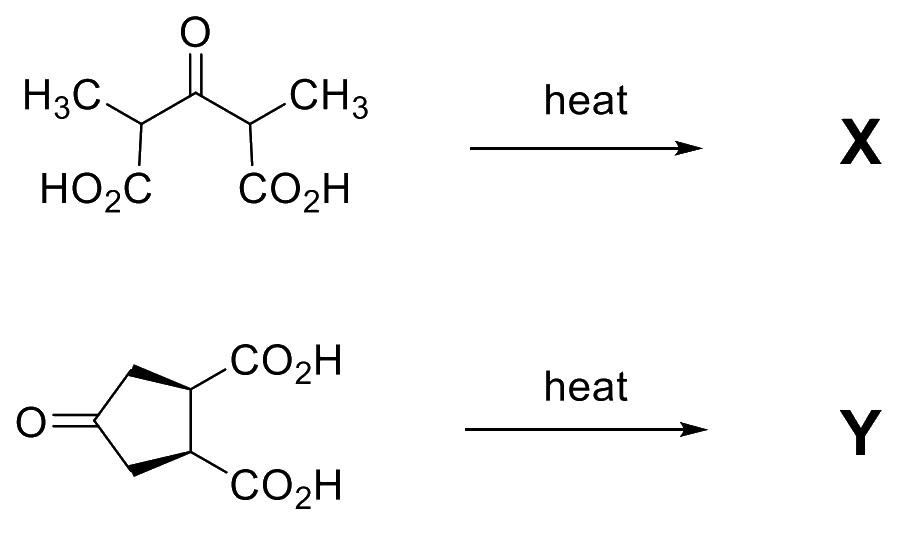
The sum of total number of carbonyl groups () present in the major products and in the following reactions is ____.
Correct answer
0
Step-by-step solution
Reaction 1:
The reactant is 2,4-dimethyl-3-oxopentanedioic acid, which is a -keto acid (both groups are at the -position with respect to the central ketone group). -keto acids readily undergo decarboxylation upon heating. Since there are two such groups, it will undergo double decarboxylation.
The major product is 3-pentanone.
Number of carbonyl groups () in .
Reaction 2:
The reactant is *cis*-3,4-dicarboxycyclopentanone. The two carboxylic acid groups are on adjacent carbons (a 1,2-dicarboxylic acid system). Heating a 1,2-dicarboxylic acid leads to dehydration, forming a stable 5-membered cyclic anhydride.
The major product is the cyclic anhydride of the reactant, which is a fused bicyclic system containing the original cyclopentanone ring and a newly formed succinic anhydride ring.
The structure of contains one ketone carbonyl group and two anhydride carbonyl groups.
Number of carbonyl groups () in .
Sum of total number of carbonyl groups in and .
Answer: