Quantrex Quantrex AcademyJEE · NEET · NDA PYQs with solutions Open app
JEE Advanced 2016Paper 2
Exam
JEE Advanced
Year
2016
Paper
Paper 2
Subject
Physics
Chapter
Current Electricity

JEE Advanced 2016 · Paper 2 · Physics · Current Electricity

Consider two identical galvanometers and two identical resistors...

Consider two identical galvanometers and two identical resistors with resistance R. If the internal resistance of the galvanometers Rc<R2,{R}_{c} < \dfrac{R}{2}, which of the following statement(s) about any one of the galvanometers
is(are) true ?Consider two identical galvanometers and two identical resistors with resistance R. If the internal resistance of theConsider two identical galvanometers and two identical resistors with resistance R. If the internal resistance of theConsider two identical galvanometers and two identical resistors with resistance R. If the internal resistance of theConsider two identical galvanometers and two identical resistors with resistance R. If the internal resistance of the
Options

  1. AThe maximum voltage range is obtained when all the components are connected in series
  2. BThe maximum voltage range is obtained when the two resistors and one galvanometer are connected in series, and the second galvanometer is connected in parallel to the first galvanometer
  3. CThe maximum current range is obtained when all the components are connected in parallel
  4. DThe maximum current range is obtained when the two galvanometers are connected in series and the combination is connected in parallel with both the resistors.

Correct answer

B. The maximum voltage range is obtained when the two resistors and one galvanometer are connected in series, and the second galvanometer is connected in parallel to the first galvanometer

Step-by-step solution

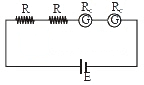
Consider two identical galvanometers and two identical resistors with resistance R. If the internal resistance of the
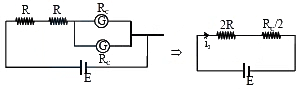
i=E2R+2RcVg1=iRc=ERc2(R+Rc)=ERc2R+2Rci = \dfrac{E}{2R + 2{R}_{c}} {V}_{{g}_{1}} = i{R}_{c} = \dfrac{E{R}_{c}}{2\left(R + {R}_{c}\right)} = \dfrac{E{R}_{c}}{2R + 2{R}_{c}}
Consider two identical galvanometers and two identical resistors with resistance R. If the internal resistance of the
i2=E2R+Rc2Vg2=i22×Rc{i}_{2} = \dfrac{E}{2R + \dfrac{{R}_{c}}{2}} {V}_{{g}_{2}} = \dfrac{{i}_{2}}{2} \times {R}_{c}
=12(E2R+Rc2)×Rc= \dfrac{1}{2}\left(\dfrac{E}{2R + \dfrac{{R}_{c}}{2}}\right) \times {R}_{c}
Vg2=ERc4R+Rc{V}_{{g}_{2}} = \dfrac{E{R}_{c}}{4R + {R}_{c}} ....(2)
Since Rc<R2(2Rc<R){R}_{c} < \dfrac{R}{2} \left(2{R}_{c} < R\right)
2R+2Rc<3R2R + 2{R}_{c} < 3R
Vg1>Vg2{V}_{{g}_{1}} > {V}_{{g}_{2}}
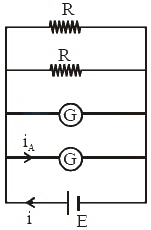
Consider two identical galvanometers and two identical resistors with resistance R. If the internal resistance of the


iA=ERc{i}_{A} = \dfrac{E}{{R}_{c}}
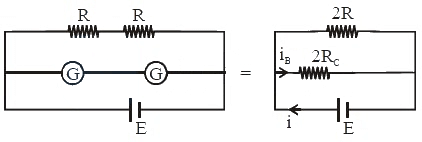
Consider two identical galvanometers and two identical resistors with resistance R. If the internal resistance of the
Here i=E(2R+2Rc)2R.2Rc=E(R+Rc)2RRci = \dfrac{E ( 2R + 2{R}_{c} )}{2R . 2{R}_{c}} = \dfrac{E ( R + {R}_{c} )}{2R{R}_{c}}
iB=2R2R+2Rc×E(R+Rc)2RRc=E2Rc{i}_{B} = \dfrac{2R}{2R + 2{R}_{c}} \times \dfrac{E ( R + {R}_{c} )}{2R{R}_{c}} = \dfrac{E}{2{R}_{c}}
iA>iB{i}_{A} > {i}_{B}
Practice Current Electricity on Quantrex Academy →

More from Current Electricity

A metal wire of cross-sectional area 0.5 mm ^2 and length 100 m is connected across a… JEE Advanced 2026As shown in the figure, the resistance of a galvanometer G can be found by the… JEE Advanced 2026The stored charge in the capacitor in steady state of the following circuit is ________ μ… JEE Main 2026A moving coil of galvanometer when shunted with 2\,Ω resistance gives a full scale… JEE Main 2026Two cells of emfs 1 V and 2 V and internal resistance 2\,Ω and 1\,Ω , respectively… JEE Main 2026Refer to the circuit diagram given below. The heat generated across the 6\,Ω resistance… JEE Main 2026In an experiment to determine the resistance of a given wire using Ohm's law, the… JEE Main 2026Under steady state condition the potential difference across the capacitor in the circuit… JEE Main 2026 Full Current Electricity list All JEE Advanced PYQs