Quantrex Quantrex AcademyJEE · NEET · NDA PYQs with solutions Open app
JEE Advanced 2016Paper 2
Exam
JEE Advanced
Year
2016
Paper
Paper 2
Subject
Physics
Chapter
Thermal Properties of Matter

JEE Advanced 2016 · Paper 2 · Physics · Thermal Properties of Matter

The ends Q and R of two thin wires, PQ and RS, are soldered...

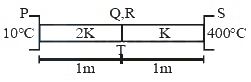
The ends Q and R of two thin wires, PQ and RS, are soldered (joined) together. Initially each of the wires has a length of 1m at 10oC.{10}^{o}C . Now the end P is maintained at 10oC,{10}^{o}C, while the end S is heated and maintained at 400oC.{400}^{o}C . The system is thermally insulated from its surroundings. If the thermal conductivity of wire PQ is twice that of the wire RS and the coefficient of linear thermal expansion of PQ is 1.2×10⁻⁵K−1,1.2 \times {10}^{- 5}{K}^{- 1}, the change in length of the wire PQ isThe ends Q and R of two thin wires, PQ and RS, are soldered (joined) together. Initially each of the wires has a lengthThe ends Q and R of two thin wires, PQ and RS, are soldered (joined) together. Initially each of the wires has a length

Options

  1. A0.78 mm
  2. B0.90 mm
  3. C1.56 mm
  4. D2.34 mm

Correct answer

A. 0.78 mm

Step-by-step solution

The ends Q and R of two thin wires, PQ and RS, are soldered (joined) together. Initially each of the wires has a length
Heat flow from P to Q
dQdt=2KA(T−10)1\dfrac{dQ}{dt} = \dfrac{2KA\left(T - 10\right)}{1}
Heat flow from Q to S
dQdt=KA(400−T)1\dfrac{dQ}{dt} = \dfrac{KA ( 400 - T )}{1}
At steady state heat flow is same in whole combination
2KA(T−10)1=KA(400−T)\dfrac{2KA\left(T - 10\right)}{1} = KA\left(400 - T\right)
2T−20=400−T2T - 20 = 400 - T
3T=4203T = 420
T=140oT = {140}^{o}
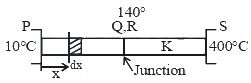
The ends Q and R of two thin wires, PQ and RS, are soldered (joined) together. Initially each of the wires has a length
Temp of junction is 140oC{140}^{o}C
Temp at a distance x from end P
Is Tx=(130x+10o){T}_{x} = \left(130x + {10}^{o}\right)
Change in length dx is dy
dy=\alphadx(Tx−10)dy = \alphadx\left({T}_{x} - 10\right)
∫0∆ydy=∫01\alphadx(130x+10−10)\mathop{∫}_{0}^{∆ y}dy = \mathop{∫}_{0}^{1}\alphadx\left(130x + 10 - 10\right)
∆y=[αx22×130]01∆ y = {\left[\dfrac{\alpha{x}^{2}}{2} \times 130\right]}_{0}^{1}
∆y=1.2×10−5×65∆ y = 1.2 \times {10}^{- 5} \times 65
∆y=78.0×10⁻⁵m=0.78mm∆ y = 78.0 \times {10}^{- 5}m = 0.78mm
Practice Thermal Properties of Matter on Quantrex Academy →

More from Thermal Properties of Matter

As shown in the figure, an insulated container is fitted with a thermally conducting but… JEE Advanced 2026The heat extracted out of x gram of water initially at 50°C to cool it down to 0°C is… JEE Main 2026The temperature of a metal strip having coefficient of linear expansion α is increased… JEE Main 2026Which of the following best represents the temperature versus heat supplied graph for… JEE Main 202610 kg of ice at -10^ ∘ C is added to 100 kg of water to lower its temperature from 25 ^ ∘… JEE Main 2026A brass wire of length 2 m and radius 1 mm at 27^ ∘ C is held taut between two rigid… JEE Main 2026Rods x and y of equal dimensions but of different materials are joined as shown in… JEE Main 2026An aluminium and steel rods having same lengths and cross-sections are joined to make… JEE Main 2026 Full Thermal Properties of Matter list All JEE Advanced PYQs