Quantrex Quantrex AcademyJEE · NEET · NDA PYQs with solutions Open app
Concepts Of Physics MCQ Edition [Volume 1]
Exam
Concepts Of Physics MCQ Edition [Volume 1]
Subject
Physics
Chapter
Dispersion and Spectra

Concepts Of Physics MCQ Edition [Volume 1] · Physics · Dispersion and Spectra

Three thin prisms are combined as shown in the figure. The...

Three thin prisms are combined as shown in the figure. The refractive indices for red, yellow, and violet rays are μr\mu_r, μy\mu_y, and μv\mu_v respectively for the crown glass, and μr′\mu_r', μy′\mu_y', and μv′\mu_v' respectively for the flint glass. Determine the ratio A′/AA'/A such that there is no net angular dispersion.
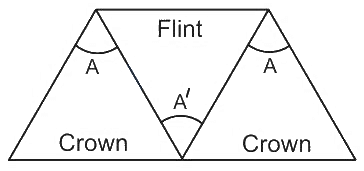
Three thin prisms are combined as shown in the figure. The refractive indices for red, yellow, and violet rays are μ_r

Options

  1. Aμv−μr2(μv′−μr′)\dfrac{\mu_v - \mu_r}{2(\mu_v' - \mu_r')}
  2. B2(μv−μr)μv′−μr′\dfrac{2(\mu_v - \mu_r)}{\mu_v' - \mu_r'}
  3. Cμv′−μr′2(μv−μr)\dfrac{\mu_v' - \mu_r'}{2(\mu_v - \mu_r)}
  4. D2(μv′−μr′)μv−μr\dfrac{2(\mu_v' - \mu_r')}{\mu_v - \mu_r}

Correct answer

B. 2(μv−μr)μv′−μr′\dfrac{2(\mu_v - \mu_r)}{\mu_v' - \mu_r'}

Step-by-step solution

The angular dispersion produced by a single thin prism of refracting angle AA is given by θ=(μv−μr)A\theta = (\mu_v - \mu_r)A.

The given combination consists of two identical crown glass prisms (each with angle AA) and one flint glass prism (with angle A′A'). The flint glass prism is placed inverted relative to the crown glass prisms.

The total angular dispersion of the combination is the sum of the dispersions of the individual prisms. Since the flint prism is inverted, its dispersion will be in the opposite direction:

θnet=θcrown+θflint+θcrown\theta_{\text{net}} = \theta_{\text{crown}} + \theta_{\text{flint}} + \theta_{\text{crown}}

θnet=(μv−μr)A−(μv′−μr′)A′+(μv−μr)A\theta_{\text{net}} = (\mu_v - \mu_r)A - (\mu_v' - \mu_r')A' + (\mu_v - \mu_r)A

θnet=2(μv−μr)A−(μv′−μr′)A′\theta_{\text{net}} = 2(\mu_v - \mu_r)A - (\mu_v' - \mu_r')A'

For no net angular dispersion, θnet=0\theta_{\text{net}} = 0:

2(μv−μr)A−(μv′−μr′)A′=02(\mu_v - \mu_r)A - (\mu_v' - \mu_r')A' = 0

(μv′−μr′)A′=2(μv−μr)A(\mu_v' - \mu_r')A' = 2(\mu_v - \mu_r)A

A′A=2(μv−μr)μv′−μr′\dfrac{A'}{A} = \dfrac{2(\mu_v - \mu_r)}{\mu_v' - \mu_r'}
Practice Dispersion and Spectra on Quantrex Academy →

More from Dispersion and Spectra

To ensure that the deviation of the mean ray is zero, a flint glass prism and a crown… Concepts Of Physics MCQ Edition [Volume 1]For red, yellow, and violet rays, the focal lengths of a convex lens are 100 cm , 98 cm… Concepts Of Physics MCQ Edition [Volume 1]As the colour of light varies from red to violet, the refractive index of a certain… Concepts Of Physics MCQ Edition [Volume 1]A specific material exhibits refractive indices of 1.56 , 1.60 , and 1.68 for red… Concepts Of Physics MCQ Edition [Volume 1]A specific material exhibits refractive indices of 1.56 , 1.60 , and 1.68 for red… Concepts Of Physics MCQ Edition [Volume 1]A thin prism is constructed from a material with refractive indices of 1.61 and 1.65 for… Concepts Of Physics MCQ Edition [Volume 1]When passing through an equilateral transparent prism, the minimum deviations experienced… Concepts Of Physics MCQ Edition [Volume 1]Two prisms of identical geometrical shape are combined such that their refracting angles… Concepts Of Physics MCQ Edition [Volume 1] Full Dispersion and Spectra list All Concepts Of Physics MCQ Edition [Volume 1] PYQs