Quantrex Quantrex AcademyJEE · NEET · NDA PYQs with solutions Open app
Concepts Of Physics MCQ Edition [Volume 1]
Exam
Concepts Of Physics MCQ Edition [Volume 1]
Subject
Physics
Chapter
Fluid Mechanics

Concepts Of Physics MCQ Edition [Volume 1] · Physics · Fluid Mechanics

Water is flowing through a horizontal tube as depicted in the...

Water is flowing through a horizontal tube as depicted in the figure. Given that the difference in heights of the water columns in the vertical tubes is 2 cm2\text{ cm}, and the areas of cross-section at AA and BB are 4 cm24\text{ cm}^2 and 2 cm22\text{ cm}^2 respectively, determine the rate of flow of water across any section.
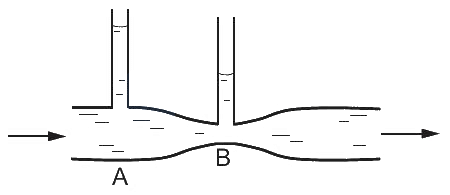
Water is flowing through a horizontal tube as depicted in the figure. Given that the difference in heights of the water

Options

  1. A73 cm3/s73 \text{ cm}^3/\text{s}
  2. B292 cm3/s292 \text{ cm}^3/\text{s}
  3. C126 cm3/s126 \text{ cm}^3/\text{s}
  4. D146 cm3/s146 \text{ cm}^3/\text{s}

Correct answer

D. 146 cm3/s146 \text{ cm}^3/\text{s}

Step-by-step solution

Given, area of cross-section at AA, A1=4 cm2A_1 = 4 \text{ cm}^2

Area of cross-section at BB, A2=2 cm2A_2 = 2 \text{ cm}^2

Difference in height of water columns, h=2 cmh = 2 \text{ cm}

Let v1v_1 and v2v_2 be the velocities of water at AA and BB respectively.

From the equation of continuity:

A1v1=A2v2A_1 v_1 = A_2 v_2

4v1=2v2⇒v2=2v14 v_1 = 2 v_2 \Rightarrow v_2 = 2 v_1

Applying Bernoulli's theorem for the horizontal tube:

P1+12ρv12=P2+12ρv22P_1 + \dfrac{1}{2} \rho v_1^2 = P_2 + \dfrac{1}{2} \rho v_2^2

P1−P2=12ρ(v22−v12)P_1 - P_2 = \dfrac{1}{2} \rho (v_2^2 - v_1^2)

The pressure difference is also given by the hydrostatic pressure of the water column difference:

P1−P2=ρghP_1 - P_2 = \rho g h

Equating the two expressions for pressure difference:

ρgh=12ρ(v22−v12)\rho g h = \dfrac{1}{2} \rho (v_2^2 - v_1^2)

2gh=(2v1)2−v12=3v122 g h = (2 v_1)^2 - v_1^2 = 3 v_1^2

v1=2gh3v_1 = \sqrt{\dfrac{2 g h}{3}}

Taking g=1000 cm/s2g = 1000 \text{ cm/s}^2:

v1=2×1000×23=40003 cm/sv_1 = \sqrt{\dfrac{2 \times 1000 \times 2}{3}} = \sqrt{\dfrac{4000}{3}} \text{ cm/s}

The rate of flow of water QQ is:

Q=A1v1=4×40003Q = A_1 v_1 = 4 \times \sqrt{\dfrac{4000}{3}}

Q≈4×36.51=146.04 cm3/s≈146 cm3/sQ \approx 4 \times 36.51 = 146.04 \text{ cm}^3/\text{s} \approx 146 \text{ cm}^3/\text{s}

Answer: 146 cm3/s146 \text{ cm}^3/\text{s}
Practice Fluid Mechanics on Quantrex Academy →

More from Fluid Mechanics

As depicted in the figure, the heights of the mercury surfaces in the two arms of a… Concepts Of Physics MCQ Edition [Volume 1]The surface of water in a water tank located on the top of a house is 4 m above the tap… Concepts Of Physics MCQ Edition [Volume 1]A glass filled completely with water has a bottom area of 20 cm^2 , a top area of 20 cm^2… Concepts Of Physics MCQ Edition [Volume 1]As shown in the figure, the cross-sectional area of the wider tube is 900 cm^2 . If the… Concepts Of Physics MCQ Edition [Volume 1]A glass filled completely with water has a bottom area of 20 cm^2 , a top area of 20 cm^2… Concepts Of Physics MCQ Edition [Volume 1]A glass full of water has a bottom area of 20 cm^2 , a height of 20 cm , and a volume of… Concepts Of Physics MCQ Edition [Volume 1]In a manometer, the heights of the mercury surfaces in its two arms are 2 cm and 8 cm .… Concepts Of Physics MCQ Edition [Volume 1]A glass full of water is enclosed by a jar, and the air within the jar is entirely… Concepts Of Physics MCQ Edition [Volume 1] Full Fluid Mechanics list All Concepts Of Physics MCQ Edition [Volume 1] PYQs