
Concepts Of Physics MCQ Edition [Volume 1]
- Exam
- Concepts Of Physics MCQ Edition [Volume 1]
- Subject
- Physics
- Chapter
- Geometrical Optics
Concepts Of Physics MCQ Edition [Volume 1] · Physics · Geometrical Optics
A cylindrical vessel with a diameter of 12 cm holds 800π cm^3 of...
A cylindrical vessel with a diameter of holds of water. A cylindrical glass piece having a diameter of and a height of is placed inside the vessel. Determine the position of the image of the vessel's bottom under the glass piece, when viewed by paraxial rays from above, as shown in the figure. The refractive index of glass is and that of water is .
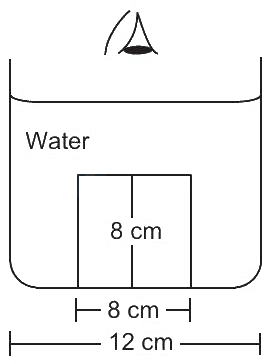
Options
- A above the bottom
- B above the bottom
- C above the bottom
- D above the bottom
Correct answer
D. above the bottom
Step-by-step solution
Volume of water initially in the vessel, .
Radius of the cylindrical vessel, .
Radius of the glass piece, .
Height of the glass piece, .
Volume of the glass piece, .
When the glass piece is placed in the vessel, it sinks to the bottom. The total volume occupied up to the new water level is:
.
The new height of the water level from the bottom is:
.
The thickness of the water layer above the glass piece is:
.
When viewed from above, the apparent shift of the bottom of the vessel is the sum of the shifts produced by the glass piece and the water layer.
Apparent shift,
Substituting and :
Therefore, the image of the bottom is formed above the actual bottom.
Answer: above the bottom