Quantrex Quantrex AcademyJEE · NEET · NDA PYQs with solutions Open app
Concepts Of Physics MCQ Edition [Volume 1]
Exam
Concepts Of Physics MCQ Edition [Volume 1]
Subject
Physics
Chapter
Geometrical Optics

Concepts Of Physics MCQ Edition [Volume 1] · Physics · Geometrical Optics

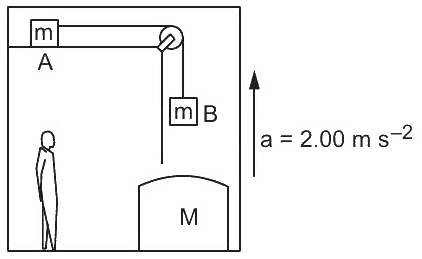
Consider the situation shown in the figure. The elevator is...

Consider the situation shown in the figure. The elevator is travelling upwards with an acceleration of 2.00 m s−22.00 \text{ m s}^{-2} and the focal length of the mirror is 12.0 cm12.0 \text{ cm}. All the surfaces are smooth and the pulley is light. At t=0t = 0, the mass–pulley system is released from rest (with respect to the elevator) when the distance of block BB from the mirror is 42.0 cm42.0 \text{ cm}. Determine the distance between the image of the block BB and the mirror at t=0.200 st = 0.200 \text{ s}. Take g=10 m s−2g = 10 \text{ m s}^{-2}.
Consider the situation shown in the figure. The elevator is travelling upwards with an acceleration of 2.00 m s^ -2 and

Options

  1. A8.57 cm8.57 \text{ cm}
  2. B8.87 cm8.87 \text{ cm}
  3. C9.33 cm9.33 \text{ cm}
  4. D20.0 cm20.0 \text{ cm}

Correct answer

A. 8.57 cm8.57 \text{ cm}

Step-by-step solution

In the frame of the elevator, the effective acceleration due to gravity is:

geff=g+a=10+2.00=12.0 m s−2g_{\text{eff}} = g + a = 10 + 2.00 = 12.0 \text{ m s}^{-2}

Let arela_{\text{rel}} be the acceleration of the blocks relative to the elevator. Writing the equations of motion for blocks A and B:

For block A: T=marelT = m a_{\text{rel}}

For block B: mgeff−T=marelm g_{\text{eff}} - T = m a_{\text{rel}}

Adding the two equations, we get:

mgeff=2marel⇒arel=geff2=12.02=6.00 m s−2m g_{\text{eff}} = 2m a_{\text{rel}} \Rightarrow a_{\text{rel}} = \dfrac{g_{\text{eff}}}{2} = \dfrac{12.0}{2} = 6.00 \text{ m s}^{-2}

The distance fallen by block B relative to the elevator in time t=0.200 st = 0.200 \text{ s} is:

s=12arelt2=12(6.00)(0.200)2=0.12 m=12.0 cms = \dfrac{1}{2} a_{\text{rel}} t^2 = \dfrac{1}{2} (6.00) (0.200)^2 = 0.12 \text{ m} = 12.0 \text{ cm}

The initial distance of block B from the mirror is 42.0 cm42.0 \text{ cm}. At t=0.200 st = 0.200 \text{ s}, its distance from the mirror becomes:

d=42.0−12.0=30.0 cmd = 42.0 - 12.0 = 30.0 \text{ cm}

Applying the sign convention, the object distance is u=−30.0 cmu = -30.0 \text{ cm}.

The mirror shown in the figure bulges towards the object, so it is a convex mirror. Its focal length is f=+12.0 cmf = +12.0 \text{ cm}.

Using the mirror formula:

1v+1u=1f\dfrac{1}{v} + \dfrac{1}{u} = \dfrac{1}{f}

1v+1−30.0=112.0\dfrac{1}{v} + \dfrac{1}{-30.0} = \dfrac{1}{12.0}

1v=112.0+130.0=5+260.0=760.0\dfrac{1}{v} = \dfrac{1}{12.0} + \dfrac{1}{30.0} = \dfrac{5 + 2}{60.0} = \dfrac{7}{60.0}

v=60.07≈8.57 cmv = \dfrac{60.0}{7} \approx 8.57 \text{ cm}

The distance between the image of block B and the mirror is 8.57 cm8.57 \text{ cm}.
Practice Geometrical Optics on Quantrex Academy →

More from Geometrical Optics

A concave mirror with a radius of curvature of 40 cm is positioned in front of an… Concepts Of Physics MCQ Edition [Volume 1]A 1 cm object is placed perpendicular to the principal axis of a convex mirror of focal… Concepts Of Physics MCQ Edition [Volume 1]A candle flame 1.6 cm high is imaged in a ball bearing of diameter 0.4 cm . If the ball… Concepts Of Physics MCQ Edition [Volume 1]A concave mirror produces an image of a 20 cm high object on a screen located 5.0 m from… Concepts Of Physics MCQ Edition [Volume 1]A concave mirror possesses a focal length of 20 cm . Determine the position or positions… Concepts Of Physics MCQ Edition [Volume 1]An object that is 3 cm tall is positioned at a distance of 7.5 cm from a convex mirror… Concepts Of Physics MCQ Edition [Volume 1]As depicted in the figure, a U-shaped wire is situated in front of a concave mirror with… Concepts Of Physics MCQ Edition [Volume 1]Determine the diameter of the image of the moon produced by a spherical concave mirror… Concepts Of Physics MCQ Edition [Volume 1] Full Geometrical Optics list All Concepts Of Physics MCQ Edition [Volume 1] PYQs