Quantrex Quantrex AcademyJEE · NEET · NDA PYQs with solutions Open app
JEE Main 202431 JanuaryMorning Shift
Exam
JEE Main
Year
2024
Date
31 January
Shift
Morning Shift
Subject
Physics
Chapter
Motion in One Dimension

JEE Main 2024 · 31 January · Morning Shift · Physics · Motion in One Dimension

A small steel ball is dropped into a long cylinder containing...

A small steel ball is dropped into a long cylinder containing glycerine. Which one of the following is the correct representation of the velocity time graph for the transit of the ball?A small steel ball is dropped into a long cylinder containing glycerine. Which one of the following is the correctA small steel ball is dropped into a long cylinder containing glycerine. Which one of the following is the correctA small steel ball is dropped into a long cylinder containing glycerine. Which one of the following is the correctA small steel ball is dropped into a long cylinder containing glycerine. Which one of the following is the correctA small steel ball is dropped into a long cylinder containing glycerine. Which one of the following is the correct
Options

  1. AIn an open organ pipe _ 3 and _ 6 are 3^ rd and 6^ th harmonic frequencies, respectively. If _ 6 - _ 3 =2200 ~Hz then
  2. BIn an open organ pipe _ 3 and _ 6 are 3^ rd and 6^ th harmonic frequencies, respectively. If _ 6 - _ 3 =2200 ~Hz then
  3. CIn an open organ pipe _ 3 and _ 6 are 3^ rd and 6^ th harmonic frequencies, respectively. If _ 6 - _ 3 =2200 ~Hz then
  4. DIn an open organ pipe _ 3 and _ 6 are 3^ rd and 6^ th harmonic frequencies, respectively. If _ 6 - _ 3 =2200 ~Hz then

Correct answer

B. In an open organ pipe _ 3 and _ 6 are 3^ rd and 6^ th harmonic frequencies, respectively. If _ 6 - _ 3 =2200 ~Hz then

Step-by-step solution

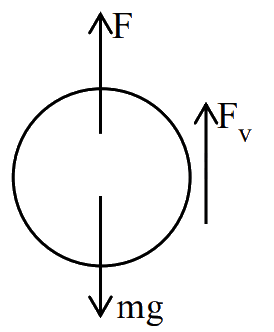
Consider a small steel ball as shown below:

A small steel ball is dropped into a long cylinder containing glycerine. Which one of the following is the correct

As shown in diagram, buoyancy force FB=F{F}_{B} = F.

Applying Newton's second law, we get

mg−FB−Fv=mamg - {F}_{B} - {F}_{v} = ma

⇒(ρ43πr3)g−(ρL43πr3)g−6πηrv=mdvdt⇒ \left(ρ\dfrac{4}{3}\pi{r}^{3}\right)g - \left({ρ}_{L}\dfrac{4}{3}\pi{r}^{3}\right)g - 6\piηrv = m\dfrac{dv}{dt}

Let 43mπR3g(ρ−ρL)=K1\dfrac{4}{3m}\pi{R}^{3}g\left(ρ - {ρ}_{L}\right) = {K}_{1} and 6πηrm=K2\dfrac{6\piηr}{m} = {K}_{2}, then we get

⇒dvdt=K1−K2v⇒ \dfrac{dv}{dt} = {K}_{1} - {K}_{2}v

Integrating both sides, we get

⇒∫0vdvK1−K2v=∫0tdt⇒ {∫}_{0}^{v}\dfrac{dv}{{K}_{1} - {K}_{2}v} = {∫}_{0}^{t}dt

⇒−1K2ln[K1−K2v]0v=t⇒ - \dfrac{1}{{K}_{2}}ln{{\left[{K}_{1} - {K}_{2}v\right]}_{0}}^{v} = t

⇒ln⁡(K1−K2vK1)=−K2t⇒ \ln \left(\dfrac{{K}_{1} - {K}_{2}v}{{K}_{1}}\right) = - {K}_{2}t

⇒K1−K2v=K1e−K2t⇒ {K}_{1} - {K}_{2}v = {K}_{1}{e}^{- {K}_{2}t}

⇒v=K1K2[1−e−K2t]⇒ v = \dfrac{{K}_{1}}{{K}_{2}}\left[1 - {e}^{- {K}_{2}t}\right]

Clearly, option B matches with the given variation of velocity with time.

Practice Motion in One Dimension on Quantrex Academy →

More from Motion in One Dimension

A gas balloon is going up with a constant velocity of 10 m/s. When this balloon reached a… JEE Main 2026Two masses of 3.4 kg and 2.5 kg are accelerated from an initial speed of 5 m/s and 12… JEE Main 2026The velocity ( v ) versus time ( t ) plot of a particle is shown in the figure, for a… JEE Main 2026From 18 m height above the ground a ball is dropped from rest. The height above the… JEE Main 2026Two cars A and B are moving in the same direction along a straight line with speeds 100… JEE Main 2026The velocity of a particle is given as v = -x i + 2y j - z k m/s. The magnitude of… JEE Main 2026A particle starts moving from time t=0 and its coordinate is given as x(t)=4 t^ 3 -3 t A.… JEE Main 2026Water drops fall from a tap on the floor, 5 m below, at regular intervals of time, the… JEE Main 2026 Full Motion in One Dimension list All JEE Main PYQs