Quantrex Quantrex AcademyJEE · NEET · NDA PYQs with solutions Open app
NTA Abhyas 2020
Exam
NTA Abhyas
Year
2020
Subject
Physics
Chapter
Thermal Properties of Matter

NTA Abhyas 2020 · Physics · Thermal Properties of Matter

The figure below shows an isosceles triangular frame ABC made out...

The figure below shows an isosceles triangular frame ABCABC made out of two different materials and DD is the midpoint of the side ABAB. The coefficient of thermal expansion of the rod ADBADB is α1{\alpha}_{1} and for the rods ACAC and BCBC is α2.{\alpha}_{2} . End CC is fixed and the whole system is placed on a smooth horizontal surface. When the temperature of the system increases, it is found that the distance remains fixed, then
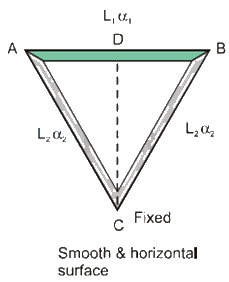
The figure below shows an isosceles triangular frame ABC made out of two different materials and D is the midpoint of

Options

  1. Al1l2=2α2α1\dfrac{{l}_{1}}{{l}_{2}} = 2\sqrt{\dfrac{{\alpha}_{2}}{{\alpha}_{1}}}
  2. Bl1l2=2α1α2\dfrac{{l}_{1}}{{l}_{2}} = 2\sqrt{\dfrac{{\alpha}_{1}}{{\alpha}_{2}}}
  3. Cl1l2=α1α2\dfrac{{l}_{1}}{{l}_{2}} = \sqrt{\dfrac{{\alpha}_{1}}{{\alpha}_{2}}}
  4. Dl1l2=α2α1\dfrac{{l}_{1}}{{l}_{2}} = \sqrt{\dfrac{{\alpha}_{2}}{{\alpha}_{1}}}

Correct answer

A. l1l2=2α2α1\dfrac{{l}_{1}}{{l}_{2}} = 2\sqrt{\dfrac{{\alpha}_{2}}{{\alpha}_{1}}}

Step-by-step solution

The figure below shows an isosceles triangular frame ABC made out of two different materials and D is the midpoint of

According to condition of the problem, height of the isosceles triangle ABCABC is unchanged. The dotted lines show configuration

After a temperature rise. Increase in length of rod AB,AB,

∆l1=l1α1∆T∆ {l}_{1} = {l}_{1}{\alpha}_{1} ∆ T

Thus A{A}^{′} = 1 / 2{l}_{1}{\alpha}_{1} ∆ T

We draw a normal from AA to A′C (the final length of ACAC ). Increase in length of ACAC is A′N

{A}^{′}N = {l}_{2}{\alpha}_{2} ∆ T

Considering increase in angle θ\theta to be very small.

{A}^{′}N ≃ A{A}^{′}cos \theta

Where cosθ=l12l2cos \theta = \dfrac{{l}_{1}}{2{l}_{2}}

Thus, we have l2α2∆T={l}_{2}{\alpha}_{2} ∆ T =\left(\dfrac{1}{2}{l}_{1}{\alpha}_{1} ∆ T\right)(l12l2)\left(\dfrac{{l}_{1}}{2{l}_{2}}\right)

Hence l1l2=2α2α2\dfrac{{l}_{1}}{{l}_{2}} = 2\sqrt{\dfrac{{\alpha}_{2}}{{\alpha}_{2}}}
Practice Thermal Properties of Matter on Quantrex Academy →

More from Thermal Properties of Matter

As shown in the figure, an insulated container is fitted with a thermally conducting but… JEE Advanced 2026The heat extracted out of x gram of water initially at 50°C to cool it down to 0°C is… JEE Main 2026The temperature of a metal strip having coefficient of linear expansion α is increased… JEE Main 2026Which of the following best represents the temperature versus heat supplied graph for… JEE Main 202610 kg of ice at -10^ ∘ C is added to 100 kg of water to lower its temperature from 25 ^ ∘… JEE Main 2026A brass wire of length 2 m and radius 1 mm at 27^ ∘ C is held taut between two rigid… JEE Main 2026Rods x and y of equal dimensions but of different materials are joined as shown in… JEE Main 2026An aluminium and steel rods having same lengths and cross-sections are joined to make… JEE Main 2026 Full Thermal Properties of Matter list All NTA Abhyas JEE Main PYQs