
JEE Advanced 2026Paper 1
- Exam
- JEE Advanced
- Year
- 2026
- Paper
- Paper 1
- Subject
- Chemistry
- Chapter
- Alcohols Phenols and Ethers
JEE Advanced 2026 · Paper 1 · Chemistry · Alcohols Phenols and Ethers
Considering LiBH_4 reduces an ester group to the corresponding...
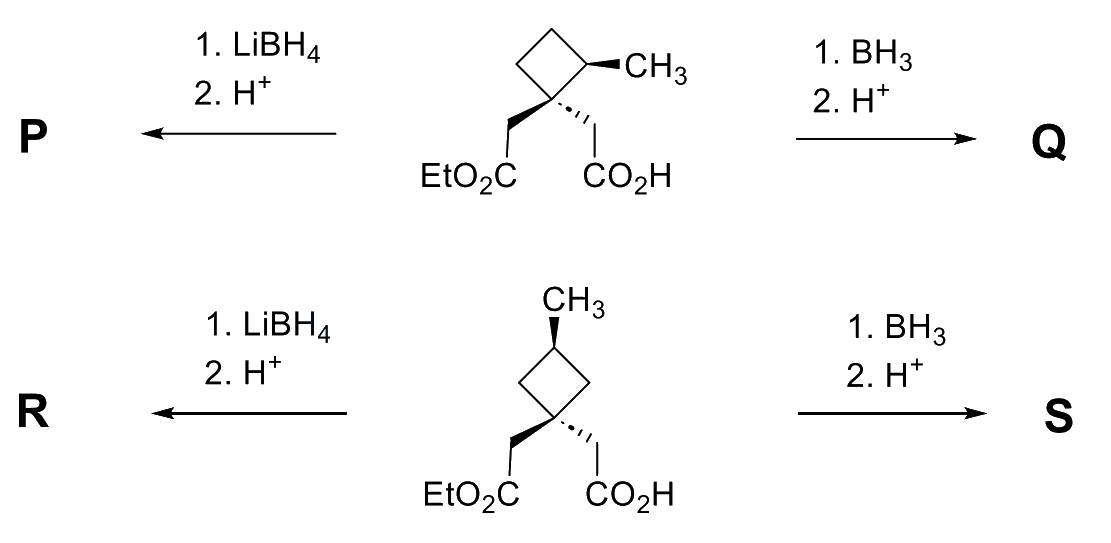
Considering reduces an ester group to the corresponding alcohol and does not reduce a carboxylic acid group, the correct statement about the major products , , and is
Options
- A & are identical, and & are diastereomers.
- B & are diastereomers, and & are identical.
- C & are diastereomers, and & are diastereomers.
- D & are identical, and & are identical.
Correct answer
C. & are diastereomers, and & are diastereomers.
Step-by-step solution
From the given statement, selectively reduces the ester group () to an alcohol () and leaves the carboxylic acid () unchanged.
Borane (), on the other hand, is a well-known reagent for the chemoselective reduction of carboxylic acids to alcohols in the presence of esters.
Let us analyze the first set of reactions yielding P and Q:
The starting material is a 1,2-disubstituted cyclobutane derivative. At C1, the ester group () is on a wedge (up) and the acid group () is on a dash (down). The adjacent C2 has a methyl group.
In product P (using ), the wedge is reduced. Thus, the new group is on the wedge.
In product Q (using ), the dash is reduced. Thus, the new group is on the dash.
Comparing P and Q, the stereocenter at C1 is inverted relative to the unchanged stereocenter at C2. Since their relative stereochemistry (cis vs trans relationship between and ) is different, P and Q are diastereomers.
Now let us analyze the second set of reactions yielding R and S:
The starting material is a 1,3-disubstituted cyclobutane derivative. At C1, is on a wedge and is on a dash. At C3, there is a methyl group.
In product R (using ), the ester on the wedge is reduced. The resulting group is on the wedge (cis to the methyl group if we assume methyl is up).
In product S (using ), the acid on the dash is reduced. The resulting group is on the dash (trans to the methyl group).
Since R and S represent the cis and trans isomers of a 1,3-disubstituted cycloalkane, they are stereoisomers that are not mirror images. Therefore, R and S are also diastereomers.
Thus, P & Q are diastereomers, and R & S are diastereomers.