Quantrex Quantrex AcademyJEE · NEET · NDA PYQs with solutions Open app
JEE Advanced 2026Paper 1
Exam
JEE Advanced
Year
2026
Paper
Paper 1
Subject
Chemistry
Chapter
Chemical Kinetics

JEE Advanced 2026 · Paper 1 · Chemistry · Chemical Kinetics

For a reversible reaction R leftharpoons P , at constant...

For a reversible reaction R⇌P\text{R} \rightleftharpoons \text{P}, at constant temperature, both the forward and the backward reactions are first order elementary reactions with rate constants kfk_f and kbk_b, respectively. At time zero, the concentration of R\text{R} is [R]0[\text{R}]_0 and the concentration of P\text{P} is zero. At any given time, [R][\text{R}] and [P][\text{P}] are the concentrations of R\text{R} and P\text{P}, respectively. If kb=4kfk_b = 4k_f, the correct graphical representation of the reaction isFor a reversible reaction R leftharpoons P , at constant temperature, both the forward and the backward reactions areFor a reversible reaction R leftharpoons P , at constant temperature, both the forward and the backward reactions areFor a reversible reaction R leftharpoons P , at constant temperature, both the forward and the backward reactions areFor a reversible reaction R leftharpoons P , at constant temperature, both the forward and the backward reactions areFor a reversible reaction R leftharpoons P , at constant temperature, both the forward and the backward reactions are
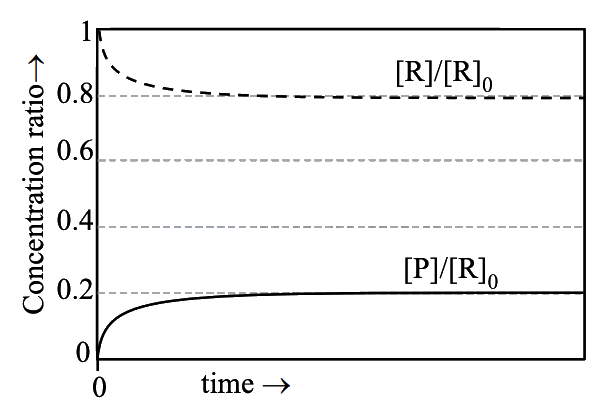
Options

  1. AIn ammonium - phosphomolybdate, the oxidation state of Mo is + _______
  2. BIn ammonium - phosphomolybdate, the oxidation state of Mo is + _______
  3. CIn ammonium - phosphomolybdate, the oxidation state of Mo is + _______
  4. DIn ammonium - phosphomolybdate, the oxidation state of Mo is + _______

Correct answer

C. In ammonium - phosphomolybdate, the oxidation state of Mo is + _______

Step-by-step solution

For the reversible first-order reaction R⇌P\text{R} \rightleftharpoons \text{P}, at equilibrium, the rate of the forward reaction equals the rate of the backward reaction.

kf[R]eq=kb[P]eqk_f [\text{R}]_{eq} = k_b [\text{P}]_{eq}

Given kb=4kfk_b = 4k_f, we can substitute this into the equilibrium condition:

kf[R]eq=4kf[P]eqk_f [\text{R}]_{eq} = 4k_f [\text{P}]_{eq}

[R]eq=4[P]eq[\text{R}]_{eq} = 4[\text{P}]_{eq}

From the conservation of mass, the total concentration remains constant at any time tt:

[R]eq+[P]eq=[R]0[\text{R}]_{eq} + [\text{P}]_{eq} = [\text{R}]_0

Substituting [R]eq=4[P]eq[\text{R}]_{eq} = 4[\text{P}]_{eq} into the mass balance equation gives:

4[P]eq+[P]eq=[R]04[\text{P}]_{eq} + [\text{P}]_{eq} = [\text{R}]_0

5[P]eq=[R]05[\text{P}]_{eq} = [\text{R}]_0

[P]eq=0.2[R]0[\text{P}]_{eq} = 0.2[\text{R}]_0

Using this to find [R]eq[\text{R}]_{eq}:

[R]eq=4×0.2[R]0=0.8[R]0[\text{R}]_{eq} = 4 \times 0.2[\text{R}]_0 = 0.8[\text{R}]_0

Therefore, as t→∞t \to \infty, the concentration ratio [P][R]0\dfrac{[\text{P}]}{[\text{R}]_0} approaches 0.20.2 and [R][R]0\dfrac{[\text{R}]}{[\text{R}]_0} approaches 0.80.8. This is correctly represented in the third graph.

Answer: For a reversible reaction R leftharpoons P , at constant temperature, both the forward and the backward reactions are
Practice Chemical Kinetics on Quantrex Academy →

More from Chemical Kinetics

For a first-order reaction R P at a given temperature, k is the rate constant. For this… JEE Advanced 2026Given below are two statements: R=8.314 J K ^ -1 mol ^ -1 and 1 cal =4.2 J Statement I… JEE Main 2026Decomposition of a hydrocarbon follows the equation k = (5.5 × 10^ 11 \,s^ -1 )\,e^… JEE Main 2026For a reaction A arrow P at T K , the half life (t_ 1/2 ) is plotted as a function of… JEE Main 2026First order gas phase reaction A arrow B + C p_i = initial pressure of gas A, p_t = total… JEE Main 2026If the half life of a first order reaction is 6.93 minutes then the time required for… JEE Main 2026Consider the given graph showing variation of reactant concentration with time. Three… JEE Main 2026For a first order reaction A arrow B t/min [A]/M 0 0.6500 x 0.0650 20 0.00065 x= ______… JEE Main 2026 Full Chemical Kinetics list All JEE Advanced PYQs