
JEE Main 20268 AprilEvening Shift
- Exam
- JEE Main
- Year
- 2026
- Date
- 8 April
- Shift
- Evening Shift
- Subject
- Chemistry
- Chapter
- Chemical Kinetics
JEE Main 2026 · 8 April · Evening Shift · Chemistry · Chemical Kinetics
Given below are two statements: R=8.314 J K ^ -1 mol ^ -1 and 1 cal...
Given below are two statements:
J K mol and cal J
Statement I: When kcal/mol, the room temperature rate constant is doubled by a 10\,^\circC increase in temperature ( K to K)
Statement II: For a first order reactions A B,
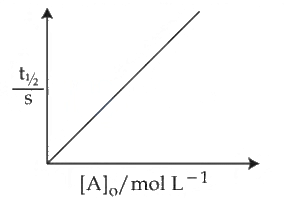
Here is the initial concentration of A and is half life of reaction.
In the light of the above statements, choose the correct answer from the options given below:
J K mol and cal J
Statement I: When kcal/mol, the room temperature rate constant is doubled by a 10\,^\circC increase in temperature ( K to K)
Statement II: For a first order reactions A B,
Here is the initial concentration of A and is half life of reaction.
In the light of the above statements, choose the correct answer from the options given below:
Options
- ABoth Statement I and Statement II are true
- BBoth Statement I and Statement II are false
- CStatement I is true but Statement II is false
- DStatement I is false but Statement II is true
Correct answer
C. Statement I is true but Statement II is false
Step-by-step solution
For Statement I:
According to the Arrhenius equation:
Given that the rate constant doubles, . The temperatures are K and K.
The gas constant J K mol cal K mol cal K mol.
Substituting the values:
cal/mol kcal/mol.
Thus, Statement I is true.
For Statement II:
For a first order reaction, the half-life is given by:
This indicates that the half-life of a first order reaction is independent of the initial concentration . The graph of versus should be a horizontal line parallel to the concentration axis.
The given graph shows directly proportional to , which corresponds to a zero order reaction ().
Thus, Statement II is false.
Therefore, Statement I is true but Statement II is false.
Answer: Statement I is true but Statement II is false