Quantrex Quantrex AcademyJEE · NEET · NDA PYQs with solutions Open app
JEE Advanced 2017Paper 1
Exam
JEE Advanced
Year
2017
Paper
Paper 1
Subject
Chemistry
Chapter
States of Matter

JEE Advanced 2017 · Paper 1 · Chemistry · States of Matter

An ideal gas is expanded from ( p _ 1 , V _ 1 , T _ 1 ) to ( p _ 2...

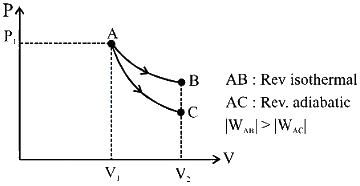
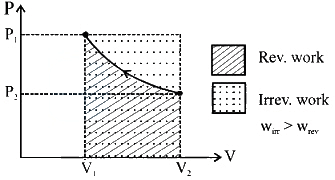
An ideal gas is expanded from (p1,V1,T1)to(p2,V2,T2)( {p}_{1}, {V}_{1}, {T}_{1} ) to ( {p}_{2}, {V}_{2}, {T}_{2} ) under different conditions. The correct statement(s) among the following is(are)An ideal gas is expanded from ( p _ 1 , V _ 1 , T _ 1 ) to ( p _ 2 , V _ 2 , T _ 2 ) under different conditions. TheAn ideal gas is expanded from ( p _ 1 , V _ 1 , T _ 1 ) to ( p _ 2 , V _ 2 , T _ 2 ) under different conditions. The
Options

  1. AThe work done on the gas is maximum when it is compressed irreversibly from ( p2,V2){p}_{2}, {V}_{2} ) to (p1,V1)( {p}_{1}, {V}_{1} ) against constant pressure p1{p}_{1}
  2. BIf the expansion is carried out freely, it is simultaneously both isothermal as well as adiabatic
  3. CThe work done on the gas is less when it is expanded reversibly from V1toV2{V}_{1}to{V}_{2} under adiabatic conditions as compared to that when expanded reversibly from V1toV2{V}_{1}to{V}_{2} under isothermal conditions.
  4. DThe change in internal energy of the gas (i) zero, if it is expanded reversibly with T1=T2{T}_{1} = {T}_{2} , and (ii) positive, if it is expanded reversibly under adiabatic conditions with T1≠T2{T}_{1} \ne {T}_{2}

Correct answer

A. The work done on the gas is maximum when it is compressed irreversibly from ( p2,V2){p}_{2}, {V}_{2} ) to (p1,V1)( {p}_{1}, {V}_{1} ) against constant pressure p1{p}_{1}

Step-by-step solution

(I)

 An ideal gas is expanded from ( p _ 1 , V _ 1 , T _ 1 ) to ( p _ 2 , V _ 2 , T _ 2 ) under different conditions. The

(II) 

An ideal gas is expanded from ( p _ 1 , V _ 1 , T _ 1 ) to ( p _ 2 , V _ 2 , T _ 2 ) under different conditions. The

(III)  (i) \DeltaU=nCv\DeltaT=0\DeltaU = n{C}_{v}\DeltaT = 0 (isothermal hence \DeltaT=0\DeltaT = 0)

(ii)   \DeltaU=q+w=−ve(q=0,w<0)\DeltaU = q + w = - ve\left(q = 0, w < 0\right)

(IV)   q=0q = 0 (adiabatic), w=0w = 0 (free expansion)

\DeltaU=0⇒\DeltaT=0\DeltaU = 0 ⇒ \DeltaT = 0 (isothermal)

Practice States of Matter on Quantrex Academy →

More from States of Matter

Two cylinders, both fitted with frictionless pistons, are filled with mixtures of He and… JEE Advanced 2026Molar volume (V_m) of a van der Waals gas can be calculated by expressing the van der… JEE Advanced 2025At the sea level, the dry air mass percentage composition is given as nitrogen gas… JEE Main 2025For a reaction, N_2 O_ 5(~g) arrow 2 NO_ 2(~g) +(1)/(2) O_ 2(~g) in a constant volume… JEE Main 2025A closed vessel contains 10 ~g of an ideal gas X at 300 ~K , which exerts 2 atm pressure.… JEE Advanced 2024A gas has a compressibility factor of 0 . 5 and a molar volume of 0 . 4 dm ^ 3 mol ^ - 1… JEE Advanced 2023A certain quantity of real gas occupies a volume of 0 . 15 dm ^ 3 at 100atm and 500K when… JEE Main 2023At 600K , the root mean square ( rms ) speed of gas X (molar mass = 40 ) is equal to the… JEE Main 2023 Full States of Matter list All JEE Advanced PYQs