
Concepts Of Physics MCQ Edition [Volume 1]
- Exam
- Concepts Of Physics MCQ Edition [Volume 1]
- Subject
- Physics
- Chapter
- Wave Motion and Waves on a String
Concepts Of Physics MCQ Edition [Volume 1] · Physics · Wave Motion and Waves on a String
A string with a total length of 30 cm and a linear mass density of...
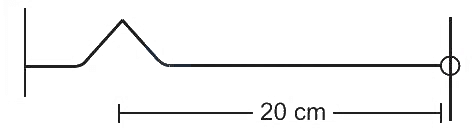
A string with a total length of and a linear mass density of is attached to a fixed wall at one end, while its other end is tied to a frictionless ring that is free to slide on a vertical rod, as shown in the figure. A wave pulse is generated on the string, travelling towards the ring at a speed of . The pulse is symmetric around its peak, which is initially situated at a distance of from the ring-joined end. Assuming reflections at the ends occur without any energy loss, determine the time taken by the string to regain its initial shape.
Options
- A
- B
- C
- D
Correct answer
A.
Step-by-step solution
Given the wave speed and the initial distance of the pulse peak from the ring is .
The time taken by the pulse to reach the ring is .
Since the ring is free to slide, it acts as a free boundary. Reflection at a free boundary occurs without any phase reversal, so the upright pulse reflects as an upright pulse moving in the opposite direction.
For the string to regain its initial spatial shape, the symmetric upright pulse must return to its original position.
The distance traveled back to the initial position is again .
The time taken for this return journey is .
The total time taken is .