
Concepts Of Physics MCQ Edition [Volume 1]
- Exam
- Concepts Of Physics MCQ Edition [Volume 1]
- Subject
- Physics
- Chapter
- Wave Motion and Waves on a String
Concepts Of Physics MCQ Edition [Volume 1] · Physics · Wave Motion and Waves on a String
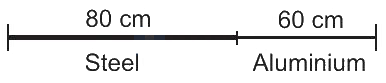
As shown in the figure, an aluminium wire of length 60 cm is...
As shown in the figure, an aluminium wire of length is connected to a steel wire of length , and the combination is stretched between two fixed supports, producing a tension of . The steel wire has a cross-sectional area of , while the aluminium wire has a cross-sectional area of . Determine the minimum frequency of a tuning fork that can set up standing waves in the system such that the joint acts as a node. (Given: the density of aluminium is and that of steel is ).
Options
- A
- B
- C
- D
Correct answer
A.
Step-by-step solution
The linear mass density of the steel wire is given by:
The linear mass density of the aluminium wire is:
Since , the wave speed is the same in both wires:
For the joint to act as a node, both wires must form standing waves with nodes at their ends. The frequency must be the same for both wires:
where and are the number of loops in the steel and aluminium wires, respectively. Equating the two expressions gives:
For the minimum frequency, and must be the smallest possible integers. Thus, and .
Substituting into the frequency formula yields:
The closest value among the given options is .
Answer: