
Concepts Of Physics MCQ Edition [Volume 1]
- Exam
- Concepts Of Physics MCQ Edition [Volume 1]
- Subject
- Physics
- Chapter
- Wave Motion and Waves on a String
Concepts Of Physics MCQ Edition [Volume 1] · Physics · Wave Motion and Waves on a String
A heavy string is fastened at one end to a movable support and at...
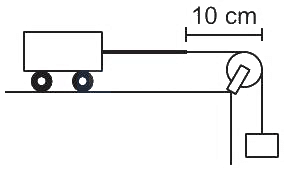
A heavy string is fastened at one end to a movable support and at the other end to a light thread, as shown in the figure. The light thread passes over a fixed pulley, suspending a weight that creates tension. The lowest resonant frequency of the heavy string is . The movable support is then pushed to the right, causing the joint to rest on the pulley. Determine the new minimum frequency at which the heavy string can resonate.
Options
- A
- B
- C
- D
Correct answer
D.
Step-by-step solution
Initially, the heavy string is fixed at the movable support and attached to a light thread at the other end. Since the light thread has negligible mass, it cannot support a transverse force. Therefore, the joint acts as a free end (an antinode) for the transverse waves in the heavy string.
For a string of length fixed at one end and free at the other, the lowest resonant (fundamental) frequency is given by:
When the movable support is pushed to the right, the entire heavy string shifts by , causing the joint to rest exactly on the fixed pulley. The pulley restricts any transverse motion, so this end now acts as a fixed end (a node).
The heavy string is now fixed at both ends. Its length remains unchanged, and the tension (provided by the suspended weight) and mass per unit length also remain constant. Thus, the wave speed is unchanged.
For a string fixed at both ends, the new lowest resonant frequency is:
Comparing the two frequencies, we get:
Substituting the given value:
Answer: