
NDA 2026
- Exam
- NDA
- Year
- 2026
- Subject
- General Ability
- Chapter
- General Science
NDA 2026 · General Ability · General Science
A light ray is falling on a face of an equilateral glass prism as...
A light ray is falling on a face of an equilateral glass prism as shown in the figure:
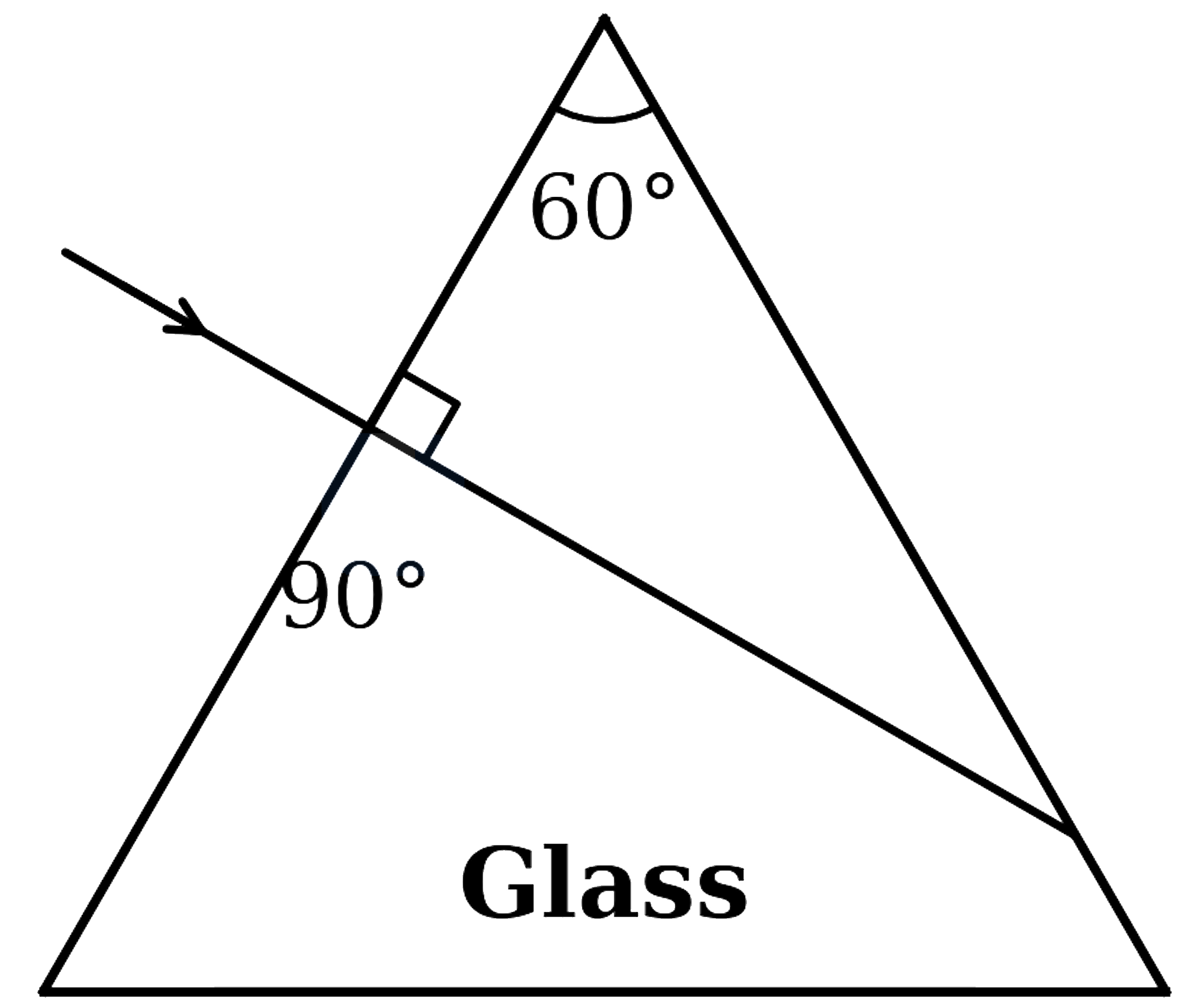
Which one of the following diagrams correctly shows the complete path of the ray through the glass prism?
Which one of the following diagrams correctly shows the complete path of the ray through the glass prism?
Options
- A

- B

- C

- D

Correct answer
D.
Step-by-step solution
When the light ray falls perpendicularly on the first face of the equilateral glass prism, its angle of incidence is . Thus, it enters the prism undeviated.
In the triangle formed at the top vertex, the angle of the prism is , and the angle at the first face is . The angle between the ray inside the prism and the second face is .
The normal to the second face makes an angle of with the surface. The angle of incidence at the second face is .
The critical angle for a glass-air interface is approximately . Since the angle of incidence () is greater than the critical angle, the ray undergoes total internal reflection.
By the law of reflection, the angle of reflection is , so the reflected ray makes an angle of with the second face.
In the triangle formed by the reflected ray, the second face, and the base, the prism's rightmost angle is . The angle the ray makes with the second face is . Therefore, the angle at which the ray strikes the base is .
Since the reflected ray strikes the base perpendicularly, its angle of incidence at the base is , and it emerges from the prism undeviated.
This complete path is correctly represented in the diagram corresponding to option (4).