
JEE Advanced 2009Paper 1
- Exam
- JEE Advanced
- Year
- 2009
- Paper
- Paper 1
- Subject
- Chemistry
- Chapter
- Chemical Bonding and Molecular Structure
JEE Advanced 2009 · Paper 1 · Chemistry · Chemical Bonding and Molecular Structure
Match each of the diatomic molecules in Column I with its...
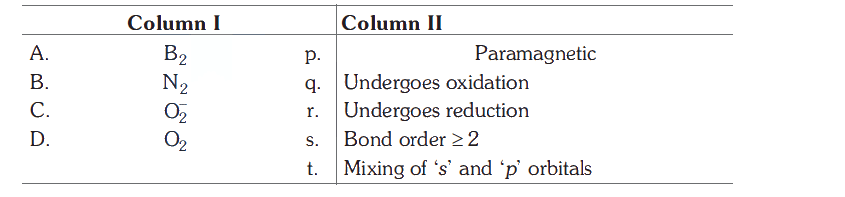
Match each of the diatomic molecules in Column I with its property/properties in Column II.
Options
- A(A) q,t, (B) s,t, (C) r,t, (D) p,q,s
- B(A) p,q,s,t, (B) p,s,t, (C) p,q, (D) r,s
- C(A) p,r,t, (B) s,t, (C) p,q,r, (D) p,r,s
- D(A) p,q,s,t, (B) p,s,t, (C) p,q, (D) r,s
Correct answer
C. (A) p,r,t, (B) s,t, (C) p,q,r, (D) p,r,s
Step-by-step solution
- A. : Has two unpaired electrons, making it p. Paramagnetic. The close energy levels of and orbitals lead to () mixing.
- B. (\boldsymbol{N}_{\mathrm{2}}) : Has a bond order of (), so its bond order is (). (). It also has () mixing and can gain electrons, so it r. Undergoes reduction.
- C. : Has two unpaired electrons, making it p. Paramagnetic. Its bond order is 2 , so it's (). (\geq) 2. With electrons in antibonding orbitals, it can lose electrons, thus q. Undergoing oxidation.
- D. : Has one unpaired electron, making it p. Paramagnetic. It can both gain and lose electrons, so it q. Undergoes oxidation and r. Undergoes reduction.
The correct option is (3).