
Concepts Of Physics MCQ Edition [Volume 1]
- Exam
- Concepts Of Physics MCQ Edition [Volume 1]
- Subject
- Physics
- Chapter
- Geometrical Optics
Concepts Of Physics MCQ Edition [Volume 1] · Physics · Geometrical Optics
A light ray strikes the face AB of a right-angled prism ABC ( μ =...
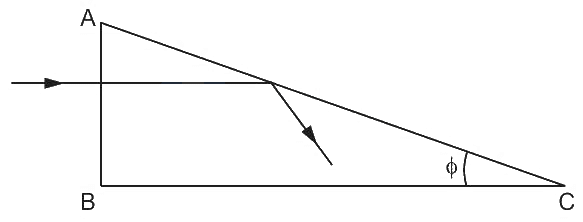
A light ray strikes the face of a right-angled prism () normally, as depicted in the figure. Determine the maximum value of the angle for which the light ray is totally internally reflected at the surface .
Options
- A
- B
- C
- D
Correct answer
B.
Step-by-step solution
When the light ray strikes the face normally, it enters the prism undeviated and travels parallel to the base .
At the surface , the angle between the incident horizontal ray and the surface is .
Therefore, the angle of incidence at the surface is given by:
For total internal reflection to occur at the surface , the angle of incidence must be greater than or equal to the critical angle of the prism:
The maximum value of is:
Taking the cosine of both sides, we get:
We know that the critical angle is given by .
Given , we have:
Substituting this value, we get:
$\phi_{\text{max}} = \cos^{-1}\left(\dfrac{2}{3}\right)