Given sets, A={(a,b)∈R×R:∣a−5∣<1and∣b−5∣<1}
A={(a,b)∈R×R:−1<a−5<1and−1<b−5<1}
A={(a,b)∈R×R:4<a<6and4<b<6}
B=9(a−6)2+4(b−5)2≤1
For set A,
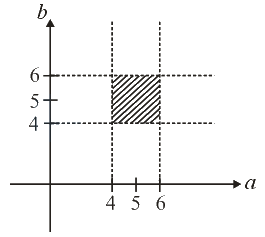
For corner coordinates of the set Ais \left(4, 4\right), \left(4, 6\right), \left(6, 4\right), \left(6, 3\right) .</p><p>ForsetB,</p><p><imgalt=""src="https://cdn−question−pool.getmarks.app/pyq/jeemain/4509ca30−3013−418e−bee8−90e2b47732bf−e0dbeab1−9c71−4364−97d7−4bdd2a7cf983−image.png"style="width:343px;height:265px;"/></p><p>Now,Put\left(4, 4\right)intheequationofthesetB,</p><p>\dfrac{4}{9} + \dfrac{1}{4} \le 1,$(4,4)lies in the set B.
Similarly, (4,6),\left(6, 4\right), \left(6, 3\right)alsoliesinthesetB .</p><p>So,A ⊂ B$.

