
NEET
- Exam
- NEET
- Subject
- Physics
- Chapter
- Electromagnetic Induction
NEET · Physics · Electromagnetic Induction
The diagram below shows two circle loops of wire (A and B) centred...
The diagram below shows two circle loops of wire (A and B) centred on and perpendicular to the -axis, and oriented with their planes parallel to each other. The -axis passes vertically through loop A (dashed line). There is a current in loop B as shown. Possible actions which we might perform on loop A are:
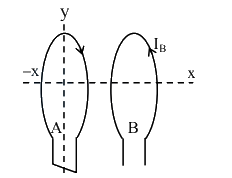
(i) Move A to the right along axis closer to (ii) Move A to the left along axis away from B (iii) As viewed from above, rotate A clockwise about y axis (iv) As viewed from above, rotate A anticlockwise about y axis Which of these actions will induce a current in A only in the direction shown.
(i) Move A to the right along axis closer to (ii) Move A to the left along axis away from B (iii) As viewed from above, rotate A clockwise about y axis (iv) As viewed from above, rotate A anticlockwise about y axis Which of these actions will induce a current in A only in the direction shown.
Options
- AOnly (i)
- BOnly (ii)
- COnly (i) and (iv)
- DOnly (ii) and (iii)
Correct answer
A. Only (i)
Step-by-step solution
When we move loop A to the right, closer to loop B, the magnetic flux through loop A increases. According to Lenz's Law, the induced current will create a magnetic field to oppose this increase. Since loop B's current () creates a magnetic field that points to the right (inside the loop) based on the right-hand rule, the induced current in loop A must create a magnetic field pointing to the left to oppose it. For loop A to create a magnetic field pointing to the left, the induced current must flow in the direction shown, which is counter-clockwise as viewed from the positive x-axis. Thus, moving A to the right induces a current in the direction shown.
When we move loop A to the left, away from loop B, the magnetic flux through loop A decreases. The induced current will again oppose this change. The induced magnetic field must now point to the right, in the same direction as the original field from loop B, to counteract the decrease in flux. This requires the induced current to flow in the opposite direction from the one shown. Therefore, moving A to the left does not induce a current in the direction shown.
Rotating loop A about the y-axis (either clockwise or counter-clockwise) while keeping its center on the x-axis does not change the amount of magnetic flux passing through it. This is because the magnetic field lines from loop B are primarily parallel to the x -axis near the center of loop A. Since the magnetic flux remains constant, no current is induced.
Based on the analysis, only action (i), moving loop A to the right along the x-axis, will induce a current in the direction shown.