
JEE Advanced 2026Paper 2
- Exam
- JEE Advanced
- Year
- 2026
- Paper
- Paper 2
- Subject
- Chemistry
- Chapter
- Amines
JEE Advanced 2026 · Paper 2 · Chemistry · Amines
In the following reaction sequence, P , Q , S and T are the major...
In the following reaction sequence, , , and are the major products.
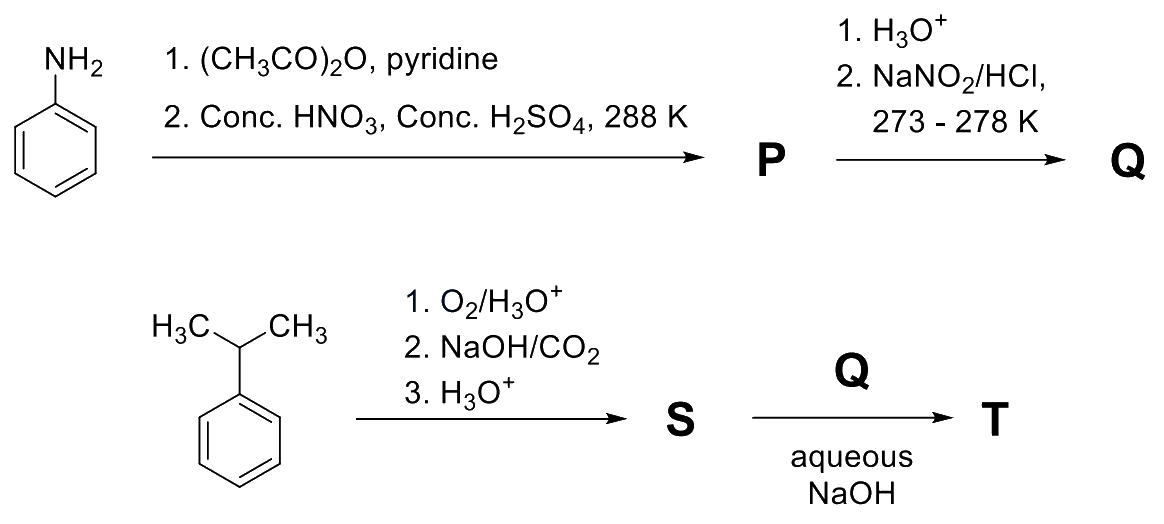
The correct statement(s) about , , and is(are)
The correct statement(s) about , , and is(are)
Options
- A on treatment with ethanol generates an aromatic aldehyde.
- B gives positive phthalein dye test.
- C is a dinitro compound.
- D is a coloured compound.
Correct answer
B. gives positive phthalein dye test.
Step-by-step solution
In the first reaction sequence:
Step 1: Aniline reacts with acetic anhydride in the presence of pyridine to undergo acetylation, forming acetanilide.
Step 2: Acetanilide is treated with a nitrating mixture (conc. and conc. ) at . The group is moderately activating and ortho/para directing. Due to steric hindrance, the major product is -nitroacetanilide.
Step 3: is hydrolyzed with to yield -nitroaniline.
Step 4: -nitroaniline is diazotized using at to form the diazonium salt , which is -nitrobenzenediazonium chloride.
In the second reaction sequence:
Step 1: Cumene (isopropylbenzene) is oxidized by followed by acid hydrolysis () to produce phenol and acetone. The major aromatic product is phenol.
Step 2: Phenol undergoes the Kolbe-Schmitt reaction with and to form sodium salicylate.
Step 3: Acidification with yields salicylic acid as the major product .
In the final reaction:
Salicylic acid () reacts with -nitrobenzenediazonium chloride () in an aqueous medium. This is an electrophilic aromatic substitution (azo coupling). The phenoxide ion formed is highly activating, and coupling occurs at the para position with respect to the group (position 5 of salicylic acid). The resulting product is an azo dye, which is a highly conjugated and coloured compound.
Evaluating the options:
(A) Treatment of (-nitrobenzenediazonium chloride) with ethanol reduces the diazonium group, yielding nitrobenzene, not an aromatic aldehyde. (Incorrect)
(B) The phthalein dye test is a characteristic test for phenols. Salicylic acid () contains a phenolic group with a free para position (position 5) and gives a positive phthalein dye test when heated with phthalic anhydride and conc. . (Correct)
(C) is -nitroacetanilide, which is a mononitro compound, not a dinitro compound. (Incorrect)
(D) is an azo dye, which is a coloured compound. (Correct)
Answer: gives positive phthalein dye test.; is a coloured compound.