
JEE Advanced 2026Paper 2
- Exam
- JEE Advanced
- Year
- 2026
- Paper
- Paper 2
- Subject
- Chemistry
- Chapter
- Amines
JEE Advanced 2026 · Paper 2 · Chemistry · Amines
Passage: Consider the following reaction sequence in which J , K ,...
Passage: Consider the following reaction sequence in which , , and are the major products.
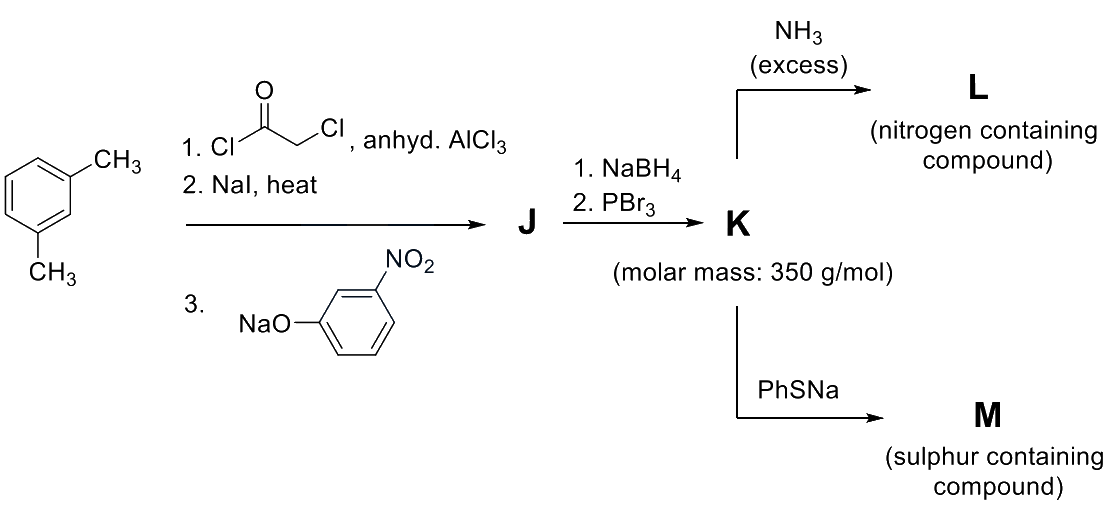
Given:
Atomic mass (in amu): H : , C : , N : , O : , S : , Br : , Ba :
Question: The volume of M aqueous required to completely neutralize the ammonia evolved from g of in Kjeldahl's method of nitrogen estimation is ____ mL.
Given:
Atomic mass (in amu): H : , C : , N : , O : , S : , Br : , Ba :
Question: The volume of M aqueous required to completely neutralize the ammonia evolved from g of in Kjeldahl's method of nitrogen estimation is ____ mL.
Correct answer
0
Step-by-step solution
The reaction sequence proceeds as follows:
1. Friedel-Crafts Acylation: Reaction of -xylene (1,3-dimethylbenzene) with chloroacetyl chloride () in the presence of anhydrous occurs at the less sterically hindered activated position (position 4) to give 1-(2,4-dimethylphenyl)-2-chloroethan-1-one.
2. Finkelstein Reaction: Heating with replaces the chloride with iodide, yielding 1-(2,4-dimethylphenyl)-2-iodoethan-1-one.
3. Williamson Ether Synthesis: Reaction with sodium 3-nitrophenoxide gives compound , which is 1-(2,4-dimethylphenyl)-2-(3-nitrophenoxy)ethan-1-one.
4. Reduction and Bromination: reduces the ketone group in to a secondary alcohol without affecting the nitro group. Subsequent reaction with converts the alcohol to a bromide, yielding compound , 1-(1-bromo-2-(3-nitrophenoxy)ethyl)-2,4-dimethylbenzene.
The molecular formula of is .
Molar mass of , which matches the given data.
5. Amination: Reaction of with excess results in nucleophilic substitution of the bromide to form a primary amine, compound , 1-(2,4-dimethylphenyl)-2-(3-nitrophenoxy)ethanamine.
The molecular formula of is .
Molar mass of .
Moles of taken = .
In Kjeldahl's method, nitrogen present in nitro () groups is not converted to ammonium sulfate and thus is not estimated. Only the nitrogen from the primary amine () group will evolve as ammonia ().
Therefore, 1 mole of yields 1 mole of .
Moles of evolved = .
The neutralization reaction with sulfuric acid is:
Moles of required = .
Given the molarity of is :
Volume of .
Answer: