
JEE Main 20262 AprilEvening Shift
- Exam
- JEE Main
- Year
- 2026
- Date
- 2 April
- Shift
- Evening Shift
- Subject
- Chemistry
- Chapter
- Alcohols Phenols and Ethers
JEE Main 2026 · 2 April · Evening Shift · Chemistry · Alcohols Phenols and Ethers
A molecule (X) with following structure under mild acidic condition...
A molecule (X) with following structure under mild acidic condition is hydrolysed to produce (Y) and (Z). Identify the correct statements about (Y) and (Z).
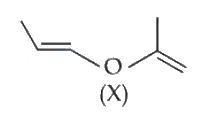
A. Both (Y) and (Z) have same molar mass.
B. (Y) and (Z) can be distinguished from each other by .
C. (Y) and (Z) react with HCN with same rates.
D. (Y) and (Z) undergo addition reaction with -DNP.
Choose the correct answer from the options given below:
A. Both (Y) and (Z) have same molar mass.
B. (Y) and (Z) can be distinguished from each other by .
C. (Y) and (Z) react with HCN with same rates.
D. (Y) and (Z) undergo addition reaction with -DNP.
Choose the correct answer from the options given below:
Options
- AA, B and C Only
- BB and C Only
- CC and D Only
- DA and D Only
Correct answer
D. A and D Only
Step-by-step solution
Molecule is an ether with two enol ether functional groups attached to the central oxygen atom. On mild acidic hydrolysis, an enol ether cleaves to give a carbonyl compound and an alcohol.
The -propenyl side hydrolyses to propanal, .
The isopropenyl side hydrolyses to the enol of acetone, which tautomerises to acetone, .
Therefore, and are propanal and acetone.
Statement A: Both and have the same molar mass.
Propanal and acetone are functional isomers with the same molecular formula and hence the same molar mass .
Statement A is true.
Statement B: and can be distinguished by .
reacts only with carboxylic acids (releasing ). Neither an aldehyde nor a ketone reacts with , so it cannot distinguish between them.
Statement B is false.
Statement C: and react with HCN at the same rate.
In nucleophilic addition to carbonyls, aldehydes react faster than ketones due to lower steric hindrance and a more electrophilic carbonyl carbon (fewer alkyl groups). So propanal reacts faster than acetone.
Statement C is false.
Statement D: and undergo addition reaction with -DNP.
Both aldehydes and ketones react with -DNP (Brady's reagent) by nucleophilic addition followed by loss of water to give coloured -dinitrophenylhydrazone precipitates.
Statement D is true.
Hence, the correct statements are A and D only, which corresponds to option .