
NEET 2026
- Exam
- NEET
- Year
- 2026
- Subject
- Physics
- Chapter
- Semiconductors
NEET 2026 · Physics · Semiconductors
An ideal Zener diode with breakdown voltage of -3 V is reverse...
An ideal Zener diode with breakdown voltage of V is reverse biased with a negative input voltage V. The magnitude of voltage difference between points and is :
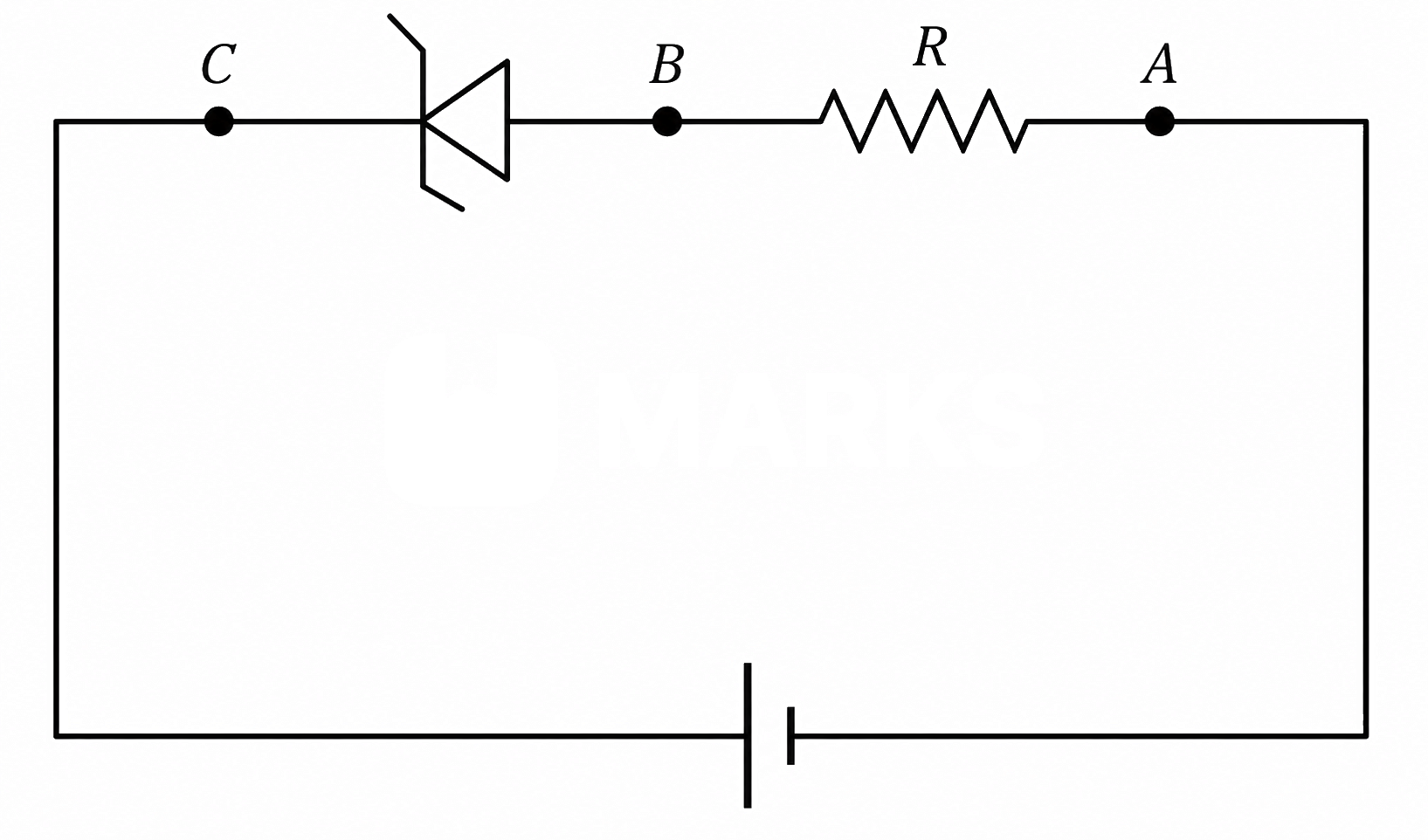
Options
- A V
- B V
- C V
- D V
Correct answer
C. V
Step-by-step solution
Given that the Zener diode is reverse biased with an input voltage of magnitude V.
The breakdown voltage of the ideal Zener diode is V.
Since the applied voltage is greater than the Zener breakdown voltage ( V V), the Zener diode operates in the breakdown region.
In the breakdown region, the voltage drop across the ideal Zener diode remains constant at its breakdown voltage. Therefore, the potential difference between points and is V.
The total voltage is applied across the series combination of the Zener diode and the resistor . By Kirchhoff's Voltage Law, the sum of the voltage drops across the Zener diode and the resistor equals the total applied voltage.
Let be the voltage difference between points and , which is the voltage across the resistor .
V.
The magnitude of the voltage difference between points and is V.
Answer: V