
MHT CET 202623 AprilEvening Shift
- Exam
- MHT CET
- Year
- 2026
- Date
- 23 April
- Shift
- Evening Shift
- Subject
- Physics
- Chapter
- Electromagnetic Induction
MHT CET 2026 · 23 April · Evening Shift · Physics · Electromagnetic Induction
The variation of induced emf (E) with time (t) in a coil if a short...
The variation of induced emf (E) with time (t) in a coil if a short bar magnet is moved along its axis with a constant velocity is best represented as North pole is situated at left end of the bar magnet and South pole is situated at right end of the bar magnet$
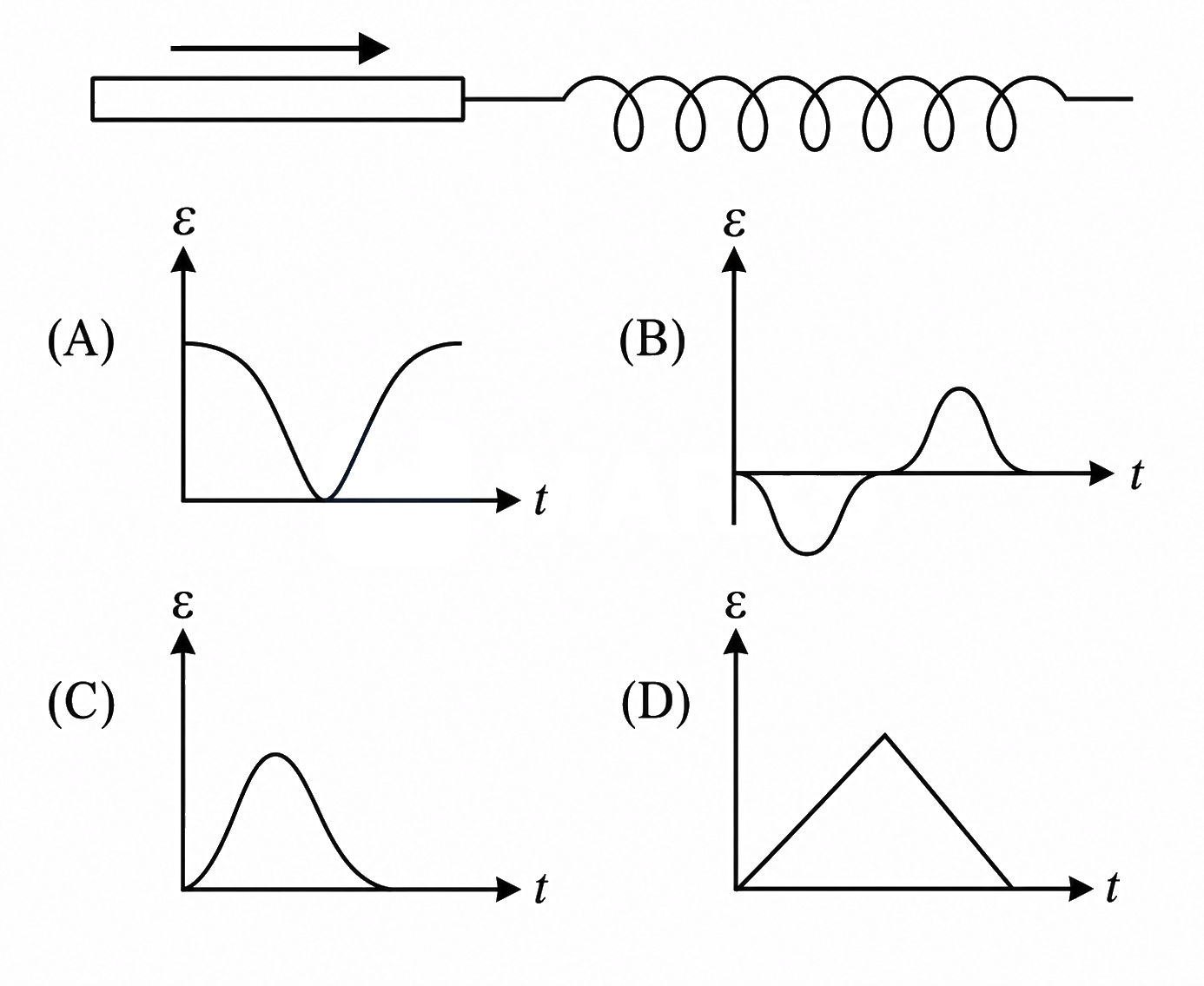
Options
- AC
- BD
- CA
- DB
Correct answer
D. B
Step-by-step solution
As the short bar magnet approaches the solenoid, the magnetic flux linked with the coil increases. According to Faraday's law of electromagnetic induction, an emf is induced. By Lenz's law, this induced emf opposes the increase in flux, resulting in an emf of a particular sign (e.g., negative).
When the short magnet is completely inside the long solenoid and moving with constant velocity, the total magnetic flux linked with the solenoid remains constant. Since the rate of change of flux is zero (), the induced emf becomes zero during this time interval.
As the magnet exits the other end of the solenoid, the magnetic flux linked with the coil decreases. This induces an emf in the opposite direction (positive) to oppose the decrease in flux.
Therefore, the induced emf first shows a pulse in one direction, then becomes zero for a while, and finally shows a pulse in the opposite direction. Only graph (B) correctly represents this variation.
Answer: B